

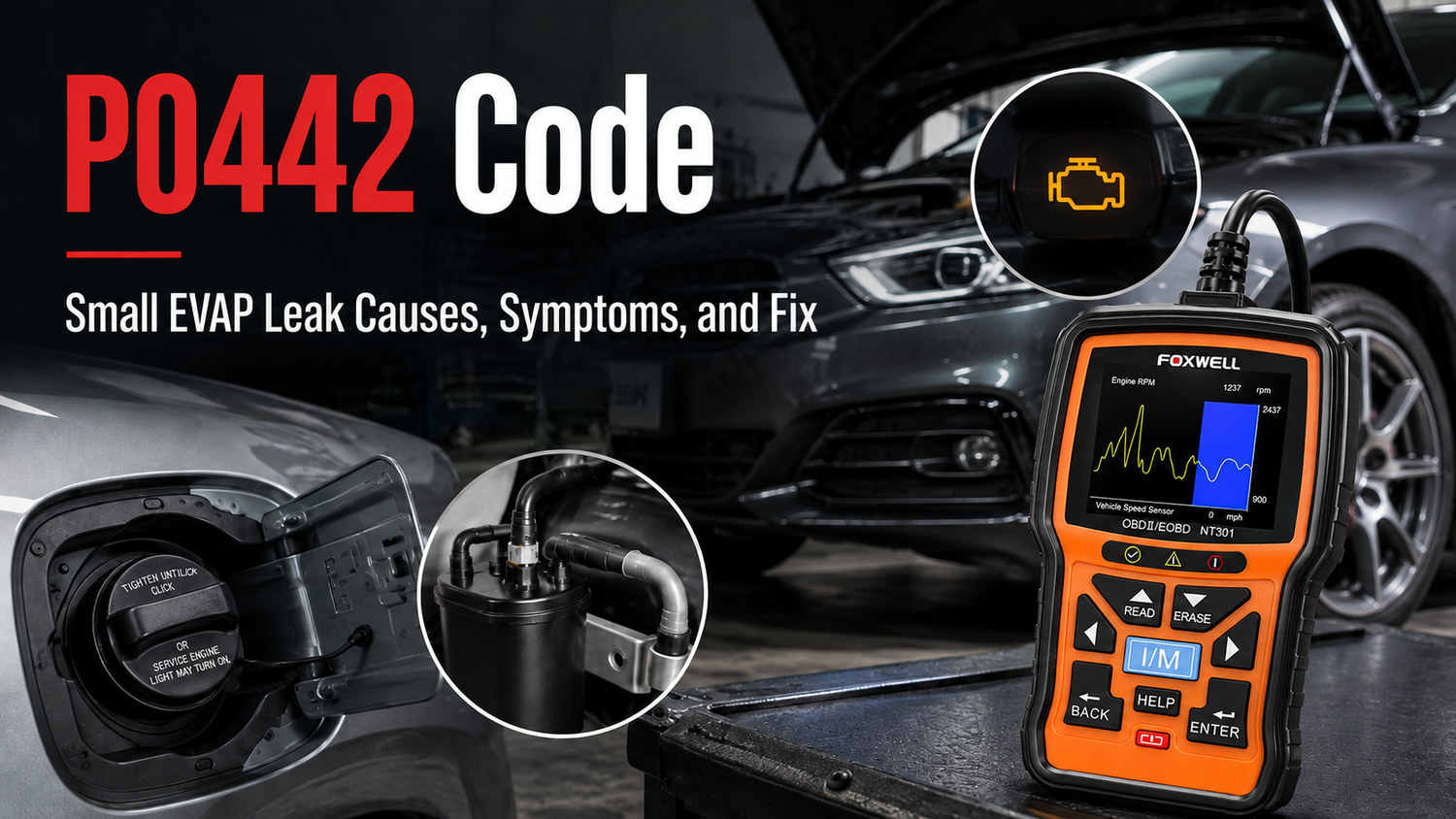
A P0442 code means the vehicle's evaporative emission control (EVAP) system has failed a small leak test. The code is generic OBD2, so the basic meaning is shared across many gasoline vehicles. The actual leak point can vary from a loose fuel cap to a cracked vapor line, a valve that does not seal, or a model specific EVAP fault.
The important point is that P0442 identifies a system level problem, not a specific failed part. A scan tool can confirm the code and provide freeze frame or readiness information, but finding a very small EVAP leak often requires inspection, valve testing, and sometimes a smoke test.
What Does the P0442 Code Mean?
P0442 is commonly defined as Evaporative Emission Control System Leak Detected (Small Leak). The EVAP system is designed to capture gasoline vapors from the fuel tank and route them back to the engine instead of allowing them to escape into the atmosphere. When the powertrain control module determines that the system cannot maintain the expected pressure or vacuum during its self test, it can store P0442.
Because P0442 is a generic powertrain code, its basic definition is not unique to Chevrolet, Volkswagen, Ford, Hyundai, or GM. What changes from one vehicle to another is how the manufacturer performs the leak test and which components are most likely to fail on a particular model or model year.
Key pointP0442 does not automatically mean you should replace the gas cap or purge valve. It means the EVAP system failed a small leak check. The exact source still has to be diagnosed. |

Figure 1. Common areas where a small EVAP leak can occur.
What Are the Possible Causes of the P0442 Code?
P0442 causes range from simple sealing problems to component faults. A small leak can be difficult to spot visually, which is why replacing parts based only on the code often wastes time and money.
|
Possible Cause |
Why It Can Set P0442 |
What to Check |
|
Loose, damaged, or incorrect fuel cap |
The cap seal may not hold the EVAP system closed during the monitor test. |
Check the cap seal, threads/locking action, and filler neck. |
|
Cracked EVAP hose, pipe, or loose connector |
A pinhole, split, or poor connection can allow vapor to escape. |
Inspect accessible vapor lines for cracks, abrasion, and disconnected fittings. |
|
Purge valve that does not seal |
A purge valve stuck partly open can prevent the system from holding the commanded vacuum. |
Test valve sealing and operation before replacement. |
|
Vent valve / vent solenoid fault |
A vent valve that cannot close can look like a system leak. |
Confirm that the valve closes and holds as specified. |
|
Cracked or damaged charcoal canister |
Housing damage or a failed connection can create a small leak. |
Inspect the canister and nearby lines, especially if exposed to impact or contamination. |
|
Filler neck, tank, pump module, or sending unit seal leak |
Seals and connections around the tank can leak even when hoses look intact. |
Inspect for fuel odor, staining, damaged seals, or smoke leakage. |
|
Fuel tank pressure sensor or leak detection system issue |
A faulty sensor or pump, or a model specific software issue, can cause an EVAP monitor failure without an obvious external leak. |
Check related DTCs, live data, service information, and applicable technical bulletins. |
GM service information, for example, notes that P0442 can be caused by a purge valve stuck open, a canister vent valve stuck open, or an unsealed EVAP connection. Volkswagen and other manufacturers also publish model specific bulletins where software, leak detection hardware, or fuel cap area issues can contribute to P0442.
What Are the Common Symptoms of the P0442 Code?
The most common P0442 symptom is simply an illuminated Check Engine Light. Many drivers do not notice any change in how the vehicle runs because the leak is small and the EVAP system mainly controls fuel vapors rather than engine power.
- Check Engine Light or stored/pending P0442 code
- Little or no noticeable drivability change in many cases
- Possible fuel vapor smell, especially near the rear of the vehicle or fuel filler area
- Possible emissions inspection failure while the MIL is on or the EVAP monitor is incomplete
- Rough idle, hesitation, hard starting, or stalling can occur if the underlying problem involves purge flow, but those are not typical symptoms of a simple small leak
If you smell raw fuelA strong fuel smell or visible liquid fuel leak should not be treated as a routine P0442 issue. Stop and inspect the vehicle for an actual fuel leak or other safety related fault. |
How to Diagnose the P0442 Code
A good P0442 diagnosis works from the easiest sealing checks toward the tests that require more equipment. Do not clear the code before recording freeze frame data and checking for related EVAP codes. Those details can help narrow the fault.
1. Confirm P0442 and Check for Related Codes
Use an OBD2 scan tool to verify P0442, note whether it is stored or pending, and record freeze frame information. Codes for purge flow, vent control, fuel tank pressure, or leak detection components may change the diagnostic direction.
For a basic home check, the Foxwell NT301 can read and clear OBD2 trouble codes, display freeze frame data, show live data, and check I/M readiness. Those functions are useful for confirming P0442 and verifying monitor status, but the scanner alone cannot tell you where a physical EVAP leak is located.
|
|

2. Inspect the Fuel Cap and Filler Neck
Remove the fuel cap and inspect the sealing surface for cracks, dirt, deformation, or damage. Check the filler neck where the cap seals. Reinstall the cap correctly. If the cap is damaged or the wrong type for the vehicle, replace it with the correct part.
3. Inspect EVAP Hoses, Pipes, and Connectors
Follow accessible vapor lines from the engine compartment toward the canister and fuel tank. Look for brittle plastic tubing, rubbed sections, cracked rubber hose, loose quick connect fittings, and damaged O rings. Small leaks may not be visible, so a hose that looks clean does not rule the system out.
4. Test the Purge Valve and Vent Valve
A purge or vent valve that does not seal can set a leak code even when no hose is cracked. Test valve operation and sealing according to the vehicle manufacturer’s service procedure. On supported vehicles, an advanced bidirectional scan tool may be able to command valves during diagnosis, but function availability is vehicle specific.
5. Smoke Test the EVAP System
If the cap, hoses, and obvious connections look good, a smoke test is one of the most effective ways to find a very small leak. Introduce smoke using an approved EVAP test method and inspect the filler area, vapor lines, canister, purge and vent connections, and fuel tank seals for escaping smoke. Always follow the vehicle service information and smoke tester instructions because EVAP systems are designed for low pressure testing.
Foxwell smoke testers such as the ST203 are designed for automotive leak detection and can be used as part of an EVAP diagnostic workflow. A smoke machine should be used to locate a leak after the code has been confirmed, not as a substitute for reading codes and service information.
6. Verify the Repair
After repairing the confirmed fault, clear the DTC if appropriate and drive the vehicle under the conditions required for its OBD monitors. Clearing codes resets readiness monitors to Not Ready. EPA guidance notes that the EVAP monitor can take longer than other monitors because it only runs when specific conditions are met, such as the required temperature and fuel level.
How to Fix the P0442 Code
The correct P0442 fix depends on what actually failed. Start with the confirmed leak or component problem rather than replacing the most common part first.
|
Confirmed Fault |
Typical Repair |
|
Fuel cap does not seal |
Clean the sealing area or replace the cap with the correct specification. |
|
Cracked EVAP hose / pipe |
Replace the damaged section or assembly and secure all connectors. |
|
Purge valve leaks when it should be closed |
Replace the purge valve only after confirming the valve does not seal or operate correctly. |
|
Vent valve fails to close or is contaminated |
Repair or replace the vent valve/vent assembly as required. |
|
Charcoal canister is cracked or damaged |
Replace the canister if the housing or ports are confirmed to leak. |
|
Tank, filler, pump-module, or seal leak |
Repair the affected seal, filler component, tank connection, or tank as required. |
|
Sensor, leak-detection pump, or software issue |
Follow the manufacturer diagnostic chart and check applicable service bulletins or software updates. |
After the repair, verify that P0442 does not return and that the EVAP monitor can complete. Simply clearing the code without fixing the underlying problem can make the Check Engine Light disappear temporarily, but the code may return when the EVAP self-test runs again.
P0442 Code by Vehicle: Chevrolet, Volkswagen, Ford, Hyundai, and GM
P0442 is a generic OBD-II code, so the basic meaning stays the same across these brands. What differs is the EVAP hardware, monitor strategy, and model-specific failure pattern. The examples below come from manufacturer technical bulletins and should be treated as diagnostic clues—not universal causes for every vehicle of that brand.
|
Vehicle / Search Intent |
Documented Examples |
Practical Takeaway |
|
Chevrolet / GM |
GM bulletin 21-NA-124 says a small leak may come from a stuck-open purge valve, stuck-open canister vent valve, or an unsealed/damaged EVAP connection. GM also advises inspecting purge-line connections and confirming leaks with appropriate testing. |
Do not assume the gas cap is the only cause. Inspect lines, purge/vent sealing, and vehicle-specific bulletins. [2] |
|
Volkswagen (VW) |
VW documents show that some model years can set P0442 from fuel-cap-area leakage, while other campaigns have linked EVAP codes to leak-detection-pump operation or ECM software. |
Check the cap/filler area, leak-detection hardware, and current VW service information for the VIN before replacing parts. |
|
Ford |
Ford SSM 49313 linked P0442/P0455/P0456/P0457 on certain 2020 Escape/Corsair vehicles to possible carbon-canister damage. Ford has also documented vapor-line damage on specific F-150 recall vehicles. |
Inspect the canister and vapor lines when the model history or underbody condition makes those areas relevant. |
|
Hyundai |
Hyundai has published model-specific cases where P0442 was related to a fuel-filler-cap sealing issue (2017 Santa Fe Sport) and to EVAP/NVLD hardware on certain Sonata Hybrid vehicles. |
Use the generic P0442 workflow, then check Hyundai service information for model-specific campaigns or component tests. |
P0442 Cost to Fix: What Should You Expect?
There is no single P0442 repair cost because the code can be caused by anything from a sealing issue to a canister or sensor problem. Current RepairPal estimates illustrate how much the price changes with the failed component: as of August 2026, average shop estimates are about $136–$148 for gas-cap replacement, $207–$248 for purge-valve replacement, and $555–$640 for fuel-evaporative-canister replacement. Taxes, location, vehicle design, diagnosis time, and related repairs can change the final bill.
The diagnosis itself may be the most time-consuming part. Tightening a cap or replacing an accessible hose can be quick, while a hidden tank-area leak may require smoke testing and disassembly. Some manufacturer repairs are highly model-specific, so there is no reliable universal labor time for “fixing P0442.”
|
Repair Area |
Cost Guidance |
Time Guidance |
|
Loose cap / simple sealing issue |
Lowest-cost scenario; may require only inspection or a replacement cap |
Minutes to inspect; replacement time is usually short |
|
Purge valve |
RepairPal average: $207–$248 (Aug. 2026) |
Often straightforward if the valve is accessible; model layout matters |
|
EVAP canister |
RepairPal average: $555–$640 (Aug. 2026) |
Can take longer when mounted near the tank or protected by underbody panels |
|
Hidden hose, seal, tank-area leak |
Highly vehicle-specific |
Diagnosis may take longer than the actual repair |
Final Takeaway
P0442 means the EVAP system has detected a small leak, but it does not tell you which part is bad. Start with the fuel cap and visible vapor lines, then test the purge and vent valves and use a smoke test if the leak remains hidden. On Chevrolet and GM, VW, Ford, and Hyundai vehicles, check model specific service information because documented P0442 causes can differ by platform and model year.
For DIY diagnosis, a basic OBD2 scanner such as the Foxwell NT301 can confirm P0442, capture freeze frame data, and check I/M readiness before and after repair. Use those data points to guide the diagnosis rather than clearing the code and guessing at parts.
FAQs
How long can I drive with code P0442?
There is no universal safe mileage or one to two week limit. If the vehicle runs normally and there is no strong fuel smell or visible fuel leak, P0442 is often not an immediate breakdown risk, but the EVAP fault should still be diagnosed soon.
Can a bad purge valve cause a P0442 code?
Yes. A purge valve that does not seal when commanded closed can prevent the EVAP system from holding vacuum and may set P0442. Confirm the valve with testing before replacing it.
How much does it cost to fix P0442?
It depends on the failed part. RepairPal’s August 2026 averages are about $207 to $248 for a purge valve and $555 to $640 for an EVAP canister. A simple cap or hose issue can cost less, while difficult repairs near the fuel tank can cost more.
How long does it take for a P0442 code to clear?
After the repair, the light may turn off after the vehicle completes enough successful self tests, or the code can be cleared with a scan tool. If you clear it manually, readiness monitors reset to Not Ready, and the EVAP monitor may need multiple drive cycles under the correct fuel level and temperature conditions.


Leave a comment
This site is protected by hCaptcha and the hCaptcha Privacy Policy and Terms of Service apply.