

Key Points
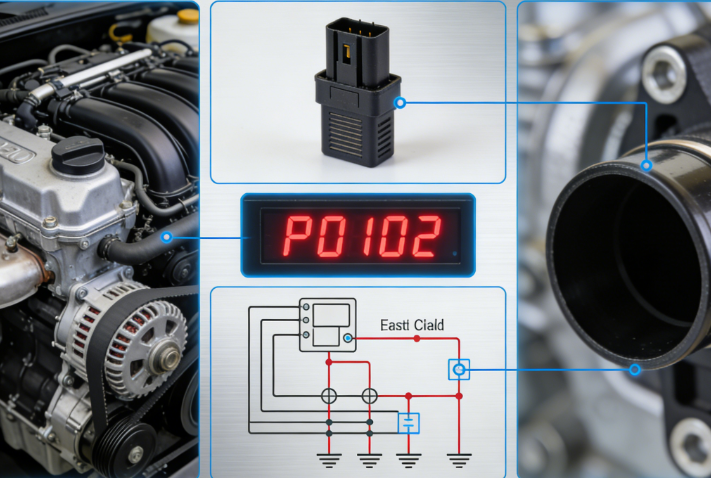
- P0102 means the PCM detects a low voltage signal from the MAF sensor circuit; it is a circuit code, not just a sensor failure.
- Top causes: electrical issues, vacuum/unmetered air leaks, airflow restrictions, sensor contamination, and low system voltage.
- Common symptoms: check engine light, rough idle, hesitation, stalling, poor fuel economy, and limp mode.
- Most P0102 cases can be fixed without replacing the MAF sensor — start with cleaning, leak checks, and wiring tests.
What Does the P0102 Code Mean?
P0102 means the engine control module (PCM/ECM) is detecting a lower-than-expected signal from the Mass Air Flow (MAF) sensor circuit.
This code directly indicates a fault in the MAF sensor circuit (not just the sensor itself) and triggers when the ECM receives implausibly low airflow data that cannot match engine operating conditions.
P0102 Core Technical Details
| Category | Key Information |
|---|---|
| MAF Sensor Basic Function | Measures intake air volume, sends variable voltage/frequency signal to ECM; higher airflow = higher signal output, lower airflow = lower signal output |
| Code Trigger Threshold | ECM sets P0102 when MAF signal stays at/below 0.1-0.5V (gasoline engines) for a set duration, even under high-airflow conditions (acceleration/moderate RPM) |
| Code Attribute | Generic (P0xxx) – core definition universal across makes/models; some manufacturers add sub-codes or adjust trigger parameters for specific engine management systems |
What Causes Low Voltage on a MAF Sensor?
Low voltage on a MAF sensor is usually caused by electrical faults, unmetered air, or airflow restriction — not just a failed sensor.
P0102 is triggered when the PCM detects a signal below the expected voltage or airflow range.

Electrical Causes (Most Critical to Check First)
Because P0102 is a circuit low code, electrical issues are a primary suspect.
Common causes:
- Weak or missing 5V reference
- Poor ground connection
- Signal wire damage or high resistance
- Corroded or loose connector pins
- Broken wires near the harness bend point
Diagnostic logic:
If voltage supply or signal return is unstable, airflow data drops — even if the sensor itself is functional.
Unmetered Air (Air Bypassing the MAF)
If air enters the engine without passing through the MAF:
- The engine receives more air than the sensor reports
- The PCM sees “low airflow” relative to engine load
- P0102 may set
Common sources:
- Vacuum leaks
- Intake manifold gasket failure
- Cracked intake boot
- Loose intake clamps
- PCV system leaks
Key principle: The MAF can only measure air that flows through it.
Airflow Restrictions
Low measured airflow can also result from restriction.
Examples:
- Severely clogged air filter
- Over-oiled aftermarket filter contaminating the sensor
- Collapsed intake duct
- Clogged catalytic converter (less common but documented)
Restriction reduces actual airflow, lowering the sensor output.
Sensor Contamination (Not Always Failure)
Dirt, oil vapor, or debris on the sensing element can:
- Reduce heat transfer
- Lower calculated airflow
- Produce artificially low voltage
This is often correctable with proper MAF cleaner.
Professional Diagnostic Insight
Before replacing the MAF:
- Verify 5V reference and ground
- Inspect wiring integrity
- Check for vacuum leaks
- Review live data (g/s vs RPM)
- Inspect intake and exhaust restrictions
Low voltage is a signal condition — not a guaranteed bad sensor.
Quick Summary Table
| Category | Typical Cause | Why It Lowers Voltage | Priority to Check |
|---|---|---|---|
| Electrical | Bad ground / broken wire | Signal drops before reaching PCM | ⭐⭐⭐⭐⭐ |
| Vacuum Leak | Intake gasket leak | Air bypasses MAF | ⭐⭐⭐⭐⭐ |
| Restriction | Clogged filter / cat | Reduced actual airflow | ⭐⭐⭐ |
| Contamination | Dirty sensor element | Reduced sensing efficiency | ⭐⭐⭐ |
Common Symptoms of P0102
P0102 commonly causes rough running, hesitation, and hard starting because incorrect MAF data disrupts fuel calculation.
When airflow is under-reported, the engine may run lean or unstable.
-
Check Engine Light (CEL)
- P0102 stored in PCM memory
- May appear alone or with lean codes (P0171/P0174)
-
Rough Idle
- Unstable RPM at idle
- Engine may shake or surge
- Cause: Incorrect airflow reading → improper fuel delivery.
-
Hesitation or Jerking Under Acceleration
- Delayed throttle response
- Bucking or stumbling
- Cause: Air-fuel mixture imbalance during load change.
-
Hard Starting
- Extended cranking
- Occasional backfire
- Cause: MAF data affects startup fuel enrichment.
-
Stalling
- Engine may die at idle or when coming to a stop
- More common if vacuum leak is present
-
Poor Fuel Economy
- PCM overcompensates for incorrect airflow
- Fuel trims shift positive or negative
-
Limp Mode (Common on GM & Some European Vehicles)
- Reduced power
- Throttle limitation
- More common on certain GM and European models.
-
Transmission Shifting Issues (Certain Models)
- Harsh shifts
- Delayed upshift
- Early downshift
- Cause: Incorrect engine load calculation affects shift strategy.
- More common on GM and Ford automatic transmissions.
The Severity of P0102 symptom varies.
| Severity Level | Symptoms | Risk Rating |
|---|---|---|
| Mild | Only Check Engine Light (CEL) | ⭐ |
| Moderate | Rough idle, hesitation, poor fuel economy | ⭐⭐⭐ |
| Severe | Stalling, no-start, extreme drivability risk | ⭐⭐⭐⭐⭐ |
P0102 symptoms result from incorrect fuel calculation, not necessarily engine damage.
Brand-Specific Insights: P0102 Across Different Makes
| Brand | Common Root Causes | Typical Associated Codes | Brand-Specific Notes |
|---|---|---|---|
| Chevy (GM) | Intake leaks, MAF contamination, wiring harness aging | P0171, P0101 | Prone to triggering Limp Mode; throttle body highly sensitive to MAF-related issues |
| Toyota | MAF contamination, incorrect air filter installation | P0171 | MAF sensors are generally durable; issues are often maintenance-related |
| Nissan | Higher MAF sensor failure rate | P0171, P0100 | MAF sensors in older models are more prone to aging |
| Ford | PCV system leaks, cracked intake pipes | P0171, P2195 | Vacuum leaks are a high-frequency root cause |
| Honda | Intake system sealing issues | P0171 | ECM is highly sensitive to air-fuel ratio corrections |
| BMW | Intake leaks, CCV system issues | 2A2C, 2AAF (brand-specific) | Often accompanied by unstable idle |
| Subaru | Poor air filter housing seal | P0171 | Often triggered after air filter replacement |
How Serious Is a P0102 Code?
P0102 is rarely a sign of catastrophic engine failure, but it is a serious drivability and safety concern that requires prompt diagnosis. Delaying repairs can lead to progressive damage, increased costs, and unsafe operation.
1. Immediate Risks (Drivability & Safety)
- Unstable idle & stalling: The vehicle may stall at traffic lights or during deceleration, creating a hazard in traffic.
- Hesitation & loss of power: Reduced throttle response and power can make merging or passing dangerous.
- Limp mode activation: Many vehicles limit RPM and power to protect the engine, severely limiting performance.
2. Progressive Damage Risks (Long-Term)
- Catalytic converter failure: A persistent lean condition from incorrect fueling can overheat and destroy the catalytic converter, a costly repair.
- O2 sensor contamination: Incorrect air-fuel ratios can damage oxygen sensors, leading to further misdiagnosis and repair costs.
- Engine misfire damage: Lean misfires can cause piston and valve damage if left unaddressed.
Can You Drive with a P0102 Code?
You can drive short distances only in an emergency to reach a repair facility, but extended driving is strongly discouraged.
While P0102 does not mean immediate engine failure, continuing to drive risks stalling in traffic, unsafe power loss, and costly long-term damage such as catalytic converter failure, oxygen sensor damage, or engine misfire issues. For safety and to avoid expensive repairs, diagnose and fix the problem as soon as possible.
How to Fix P0102?
The core logic for repairing P0102 is as follows: First, check the physical intake; then, clean the sensor dirt; next, test the circuit; and finally, replace the part. Blindly replacing the sensor often cannot solve the faults caused by wiring or air leakage.
Step 1: Visual Inspection & Airflow Basics (Zero Cost)
Before using any tools, the most obvious physical obstacles should be removed first.
- Check the air filter: A severely clogged, damp or improperly installed filter element will restrict the flow rate. If the filter element turns black or has oil stains, replace it immediately.
- Check for air intake pipe leakage (leakage at the rear section): Inspect the rubber bellows between the MAF sensor and the throttle. Look for cracks, damage, or loose clamps. Any "unmeasured air" entering at this point will cause P0102.
- Check the vacuum hose: Ensure that the small vacuum hose connected to the intake manifold is not aged, cracked or detached.
- Key operation points: Use the dedicated MAF cleaner (strictly prohibit the use of carburetor cleaning agent or compressed air; otherwise, the coating will be damaged).
- Steps: Remove the sensor, spray the sensing element 10 to 15 times to ensure complete coverage.
- Key advice: The item must be completely air-dried naturally (for about 10 minutes) before being reassembled. Do not touch the heating element with your hands.
- Voltage Test (Engine Off with Key On): Use a multimeter to measure the connector pins. Typically, there should be 12V (power supply) and 5V (reference voltage). If the voltage is missing, it is necessary to check the related fuses (such as the EFI fuse).
- Ground wire test: Ensure that the resistance between the ground wire and the body's grounding terminal is less than 0.2 ohms.
- Signal Test (Engine Running): Monitor the voltage of the signal line. Under normal circumstances, at idle speed, it should be around 0.5V to 1.5V, and increase steadily with the increase in engine speed. Any sudden change or no change in the signal indicates damage to the sensor inside.
If the operating voltage is lower than 12V, the MAF sensor will not be able to generate an accurate signal. If the battery monitor indicates that the battery is aging, replacing the battery may directly eliminate the P0102 code, and there is no need to touch the sensor.
- Purchase advice: Make sure to purchase high-quality OEM parts (such as Denso, Bosch, AC Delco). Cheap non-brand parts often have poor calibration and may trigger the P0171 (excessive fuel mixture) code immediately after installation.
- After installation: Use an OBD-II scanner to clear the fault codes and conduct a test drive.
Also read: MAF Sensor Repair: DIY Testing & Cleaning Master Guide
How to Diagnose P0102 Using a Scan Tool
Recommended Tools
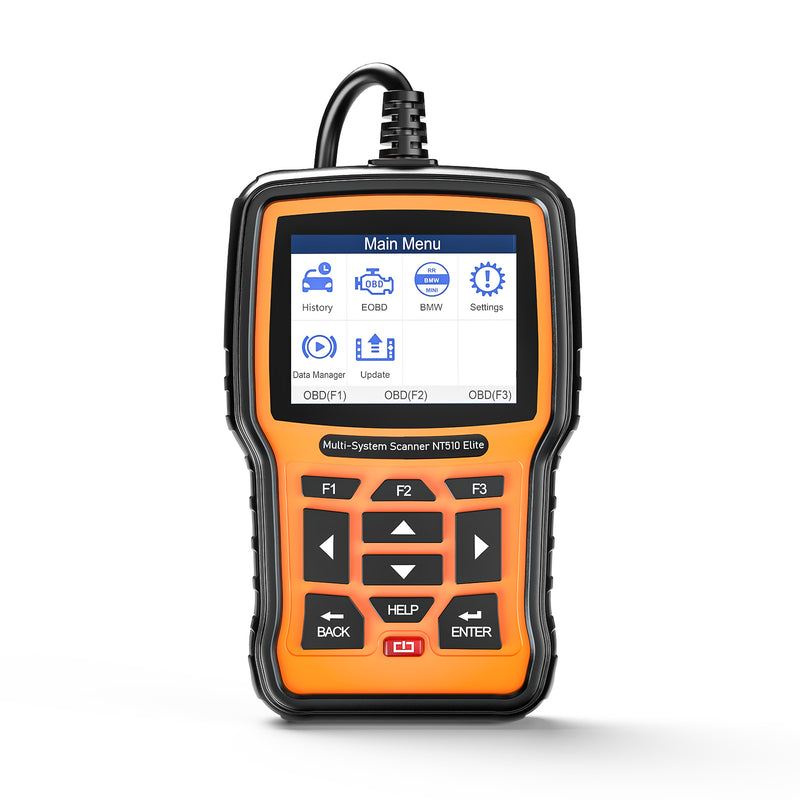
- Foxwell NT530 / NT510 / GT60 — Capable of reading live MAF sensor data, clearing diagnostic trouble codes, and performing multi-system testing.
- Foxwell NT1009 — Supports both petrol and diesel engines, with live data streaming for airflow sensor monitoring.
- Step 1: Connect a Scan Tool
Plug a reliable OBD2 scan tool into the vehicle’s diagnostic port.
Turn the ignition to the “ON” position (engine off).
- Step 2: Read and Record Fault Codes
Navigate to the diagnostic menu and select “Read Codes.”
Confirm the presence of P0102.
Record any related codes, such as P0100 (MAF circuit malfunction) or P0171 (lean mixture), which may help identify air leaks or wiring issues.
- Step 3: Check Live MAF Sensor Data
Using the scan tool, open the live data stream for the MAF sensor.
Observe the readings at idle and during revving:
Normal idle voltage: ~0.5–1.5V (varies by vehicle).
Voltage should rise smoothly with engine speed.
Sudden drops, no change, or erratic readings indicate sensor contamination, wiring faults, or intake leaks.
- Step 4: Perform System Tests (Optional)
Some Foxwell tools support active tests:
NT530 / GT60: You can check MAF signal response, compare to manufacturer specs, and even simulate engine load conditions.
This helps confirm if the sensor itself is faulty or if the problem is external (air leaks, voltage drops, vacuum issues).
- Step 5: Clear Codes and Re-Test
After inspecting the MAF readings and addressing any detected issues (cleaning sensor, fixing leaks, checking wiring), use the scan tool to clear the P0102 code.
Start the engine and monitor live data to ensure readings return to normal.
Diagnose P0102 with a Foxwell Professional Scan Tool



Check for Related Codes: What’s the Difference?
- Only P0102: Most often caused by dirty/contaminated MAF sensor, minor wiring issues, or small intake leaks. The signal is low but not accompanied by a consistent lean condition.
- P0102 + P0171 / P0174: Strong indicator of unmetered air (vacuum leak). Air enters the engine after the MAF and goes unmeasured → MAF reports low airflow (P0102) → O2 sensor detects excess oxygen → PCM logs lean codes (P0171/P0174). This is one of the most common diagnostic patterns.
- P0102 + P0562(Low System Voltage):Often a “false code” caused by a weak battery or failing alternator.MAF sensors are highly voltage‑sensitive. Low operating voltage distorts the sensor signal and triggers P0102 without actual sensor failure.
Fix first: Test battery & charging system. Repairing the battery or alternator often clears P0102 without replacing the MAF.
How Much Does It Cost to Fix a P0102 Code?
The cost to fix a P0102 code can range from under $20 to over $500, depending on the root cause. The key is to diagnose first — replacing the MAF sensor blindly is often unnecessary.
Quick & Simple DIY Fixes (Lowest Cost Options)
| Quick & Simple DIY Fixes for P0102 | Cost Range | Key Value & Critical Notes |
|---|---|---|
| Clean the MAF Sensor (Highest Priority) | $20–$50 (MAF cleaner spray) | ✅ Over 50% of P0102 cases resolved
|
| Inspect Intake Hoses & Vacuum Lines | $0–$50 | ✅ Loose clamps: Free to tighten
|
| Replace Air Filter | $30–$115 | ✅ Fixes airflow restriction from clogging/oil contamination
|
| Check Fuses (MAF Power Circuit) | $2–$10 | ✅ Cheapest possible fix
|
| Test Battery & Alternator (Eliminate Voltage Interference) | Varies (Battery: $50–$200 if replacement needed) | ✅ Fixes "false P0102" from weak/unstable voltage
|
Professional Repair Costs (If DIY Doesn't Fix It)
If the issue persists, professional repair costs may include:
| Repair Type | Typical Cost |
|---|---|
| Diagnostic fee | $80–$150 |
| Wiring repair | $50–$500 |
| Intake leak repair | $100–$650 |
| MAF sensor replacement (part + labor) | $250–$400+ |
Also read: 7 Tips for Car Auto Diagnostic Scanners for DIY Enthusiasts
Common Misdiagnosis of P0102
P0102 does not automatically mean the MAF sensor is bad. In many cases, it’s a symptom of airflow imbalance or circuit issues — not a failed sensor.
Replacing the MAF immediately is one of the most common and costly mistakes.
1. Ignoring Vacuum Leaks or Intake Gasket Failure
Unmetered air entering the engine can trigger P0102 even when the MAF is working properly.
In a real-world case discussed on Reddit (r/GMT400, Chevy 5.7L Vortec), a truck showed:
- Jerking under load
- Hard starting
- Backfiring
- Coolant leakage
The scan tool reported P0102. The owner planned to replace the MAF.
However, experienced GM technicians pointed out a known failure point on that engine:
lower intake manifold gasket leaks.
When the gasket leaks:
- Air bypasses the MAF
- The PCM sees lower-than-expected airflow
- P0102 is triggered
The issue was airflow imbalance — not a dead sensor.
Lesson: Always check for vacuum leaks and intake gasket failure before replacing the MAF.
2. Overlooking Wiring Problems (Circuit Low = Electrical Risk)
P0102 is a circuit low code. That makes wiring inspection critical.
Common issues include:
- Broken wires near the MAF connector
- Corroded terminals
- Poor ground
- Weak 5V reference
A former GM field engineer in the same discussion noted that harness stress near the connector is a frequent failure point.
Before replacing the sensor:
- Check voltage supply
- Verify ground continuity
- Wiggle-test the harness
3. Missing Airflow Restrictions
Low airflow readings can also come from restriction, not leakage.
Possible causes:
- Severely clogged air filter
- Oil-contaminated aftermarket filter (over-oiled cotton filters)
- Collapsed intake hose
- Clogged catalytic converter (documented in some cases)
Air must enter and exit properly. Restriction on either side can distort airflow calculations.
4. Misreading Severe Symptoms as Engine Failure
P0102 can cause:
- Lean misfires
- Backfiring
- Hard starts
- Stalling
- Jerking under acceleration
These symptoms feel dramatic — but they usually reflect fuel calculation errors, not internal engine damage.
Bottom Line
P0102 is often a downstream effect. Before replacing the MAF sensor:
- Check for intake or vacuum leaks
- Inspect wiring and connector integrity
- Review live MAF data
- Check fuel trims
- Rule out airflow restrictions
Replacing the sensor first may work — but proper diagnosis prevents unnecessary parts replacement.
Why P0102 Comes Back After Replacement
If you have replaced the MAF sensor but the P0102 error still occurs, it is usually because the root cause of triggering this code is not due to damage to the sensor. Below are the causes ranked by likelihood.
- Intake or Vacuum Leak (Most Common – High Probability)
Even with a new MAF sensor installed, unmetered air entering the intake system will cause airflow readings to appear too low.
- Wiring or Connector Issue (Very Common)
Replacing the sensor does not repair damaged wiring, poor grounds, or unstable voltage supply. If the MAF sensor cannot receive stable power or send a clean signal, P0102 will return regardless of sensor replacement.
- Low-Quality Aftermarket Sensor (Common)
Many inexpensive MAF sensors are poorly calibrated and produce airflow readings that are slightly lower than OEM specifications.
Some vehicles are especially sensitive to MAF calibration accuracy. If the replacement sensor is inaccurately calibrated, the ECU may still interpret the signal as “low input.”
- Battery or Charging System Voltage Problem (Moderate Probability)
Unstable system voltage can mimic a low MAF signal and repeatedly trigger P0102.
- Dirty Throttle Body or Airflow Restriction (Moderate to Low Probability)
Carbon buildup or airflow restriction downstream of the MAF can affect airflow behavior and idle readings.Airflow disruptions after the MAF can cause abnormal readings even if the sensor itself is new.
- ECU Adaptation Not Reset (Lower Probability)
If fuel trims were heavily skewed before replacement, the ECU may still operate on old learned values. Without clearing learned data, the ECU may continue operating under incorrect airflow assumptions.
Statistically, most recurring P0102 cases are caused by:
- Intake leaks
- Wiring faults
- Poor-quality replacement sensors
Replacing the MAF twice rarely solves the problem if the underlying cause was not addressed.
FAQs:
What does it mean when the mass air flow circuit is low?
- No power or weak voltage reaching the MAF
- A bad ground connection
- Wiring damage or corrosion
- A contaminated or failed MAF sensor
- Unmetered air entering the engine (vacuum leak)
Can a dirty air filter cause P0102?
How to Fix P0102 Without Replacing MAF Sensor?
- Inspect the air filter and replace it if clogged or oily.
- Check the intake boot, hoses, and intake gasket for vacuum leaks.
- Clean the MAF sensor with dedicated MAF cleaner and let it fully air dry.
- Check and repair corroded, loose, or broken wiring at the MAF connector.
- Verify 5V reference voltage and good ground connection.
- Test battery and alternator voltage to eliminate low-system-voltage issues.
Recommend reading:


Leave a comment
This site is protected by hCaptcha and the hCaptcha Privacy Policy and Terms of Service apply.