

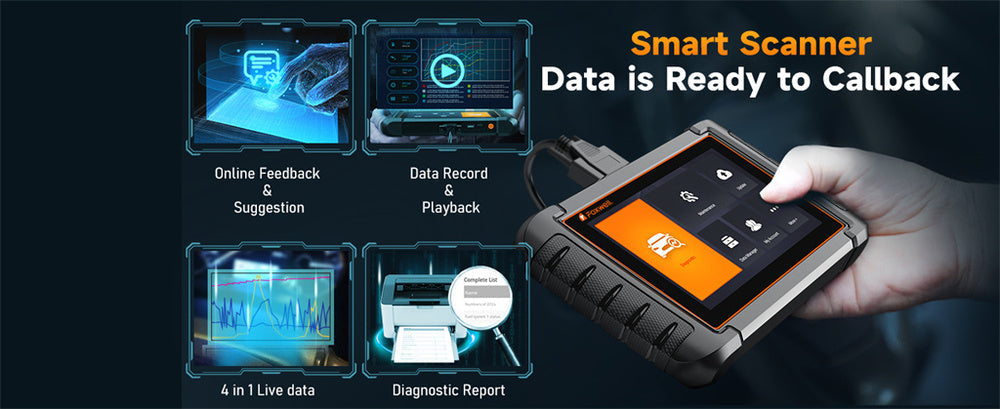
Key Points:
- Toyota hybrids are OBD2-compliant, but basic scanners may only read engine codes and miss hybrid battery or inverter data.
- Hybrid systems require deeper diagnostics because they combine a gasoline engine, electric motor, and high-voltage battery.
- Clear warning signs of a failing hybrid battery include sudden MPG drop, unstable battery charge, frequent engine cycling, and increased cooling fan noise (based on real 2019 Prius ownership experience).
- A quick 3‑step check (observe battery behavior + check warning lights + scan with a proper tool) lets you diagnose hybrid issues in 5 minutes before costly failure.
- Early battery warning signs — such as MPG drop, unstable charge levels, and frequent engine cycling — often appear before dashboard warning lights.
- For full hybrid diagnostics, use advanced scanners like Foxwell NT809BT, Autel MK808, or BlueDriver to access battery health, module voltages, and hybrid-specific codes.
As the proud owner of a Toyota Hybrid, you likely have appreciated its smooth and fuel-efficient ride. However, when that dreaded check engine light suddenly appeared, many asked: Can an OBD2 scanner be used on my Toyota Hybrid like regular gasoline cars?
Yes, Toyota Hybrid vehicles do support OBD2 scanners. But there is more to consider here. OBD2 was initially implemented during the mid-1990s to help mechanics and tech-savvy drivers like you understand what's going on inside their vehicles.
Although Toyota Hybrid vehicles are OBD2-compliant, you should keep in mind their unique nature requires more complex analysis. They combine an internal combustion engine (ICE), electric motor, and high-voltage battery.
Therefore, a standard OBD2 scanner may only give an incomplete view of hybrid health; to get a comprehensive assessment, more advanced scanning techniques must be utilized that can access both electric and gasoline systems simultaneously.
How to Use an OBD2 Scanner on a Toyota Hybrid

Scanners are relatively straightforward when used on Toyota Hybrid vehicles, with similar steps taken when scanning conventional cars. However, hybrids have specific quirks that need to be considered to avoid confusion. Users must be familiar with a few key points before starting the scanning process on any hybrid.
Locate the OBD2 port. This should be easy; most Toyota Hybrid models feature this port under their dashboard on the driver's side. Once found, plug your OBD2 scanner directly into it.
Next, start up your vehicle. Hybrid cars differ from traditional cars in that their engines don't always "start" instantly when first turned on; rather, hybrids operate in "Ready" mode, which means the car may remain running, but the engine may remain off—this doesn't affect diagnosis capabilities as long as the OBD2 scanner detects "Ready" mode.
Once connected, the scanner will begin communicating with your vehicle's onboard computer. It will generate diagnostic trouble codes (DTCs) to help identify potential engine or system issues. Once they're resolved, however, using an OBD2 scanner, you can clear them and turn off the check engine light using its check engine light indicator feature.
The process for diagnosing hybrid or electric motor vehicles using OBD2 scanners is straightforward. However, a basic scanner may only read engine-related codes. If you want deeper insights into hybrid battery or motor systems, an advanced scanner will provide a more comprehensive analysis.
Toyota Hybrid’s Special Diagnostic Needs

Toyota hybrids combine the advantages of gasoline and electric engines in one package with an electric motor and high-voltage battery storage, diagnosing problems may prove more complex than in traditional cars.
OBD2 scanners will give you information about the internal combustion engine, but you won't have access to information regarding hybrid-specific components like battery management systems and electric motors.
Hybrid batteries may deteriorate over time and suffer internal failures that might not show up on basic scanners, meaning you could miss any signs of trouble without more advanced tools like these.
Why this matters: Monitoring a hybrid system is just as vital to its overall health as monitoring any gasoline engine, so using an OBD2 scanner ensures you have access to both internal combustion engine (ICE) and electric motor diagnostics - an invaluable way to understand its overall condition.
Signs Your Toyota Hybrid Battery May Be Failing
For this article, I’m using my 2019 Toyota Prius as a real-world example. After more than five years of ownership, I began noticing gradual changes in how the hybrid system behaved. What I’m sharing here reflects actual driving experience — but it’s important to note that these symptoms can have multiple causes and should be confirmed through proper diagnostics.
1. Sudden Drop in Fuel Economy
When the battery was healthy, I averaged 50–54 MPG in city driving. As performance declined, mileage dropped to 38–42 MPG. The gasoline engine began running more frequently to compensate for reduced electric assist.
While fuel economy loss can be caused by several factors (weather, tire pressure, maintenance issues), a sharp and sustained drop often signals reduced hybrid battery efficiency.
2. Unstable Battery Charge Levels
Previously, the battery gauge would fill and drain gradually. As degradation set in, it charged only halfway and drained rapidly, even under light acceleration.
This type of unstable state-of-charge behavior is commonly associated with aging hybrid battery modules.
3. Frequent Engine Cycling
At low speeds, the Prius typically relies heavily on electric power. However, I noticed the engine cycling on and off much more aggressively, even in slow traffic.
This usually indicates the battery can no longer provide consistent electric output.
4. Reduced Electric Assist During Acceleration
Acceleration became noticeably heavier. The electric motor provided less support, forcing the gasoline engine to work harder, especially during merging or uphill driving.
5. Increased Cooling Fan Activity
Because the Prius battery sits under the rear seats, I could hear the cooling fan running more frequently and louder than before. Excess heat is a common sign of battery stress or imbalance between modules.
6. Warning Lights (Late-Stage Indicator)
Eventually, dashboard warnings appeared:
- Check Engine Light
- Hybrid System Warning
- Battery Malfunction Indicator
In many cases, warning lights appear after months of subtle performance decline — not at the beginning.
In my experience, noticeable performance changes often show up before diagnostic trouble codes do. However, these symptoms alone do not confirm battery failure.
If you observe multiple signs — especially unstable charge levels combined with fuel economy loss — using a hybrid-capable scan tool to check battery voltage balance and system codes is the safest way to confirm the condition.
Early diagnosis can help determine whether the issue is true battery degradation or another supporting component within the hybrid system.
How to Diagnose a Toyota Hybrid System in 5 Minutes
Modern Toyota hybrids are highly reliable, but when something starts to feel “off,” early diagnosis is critical. The good news is you can perform a basic hybrid system check in just a few minutes before deciding whether professional service is needed.
Here’s a simple 3-step approach.
Step 1: Check Battery Charge Behavior
Start by observing how the hybrid battery behaves during normal driving.
Ask yourself:
- Does the battery drain unusually fast?
- Does it fail to fully charge like it used to?
- Does the gas engine cycle on and off more frequently than normal?
- Does acceleration feel weaker due to reduced electric assist?
In models like the Toyota Prius, the hybrid battery should charge and discharge gradually and predictably. If you notice rapid swings in charge level or constant engine engagement at low speeds, it may indicate battery degradation or imbalance.
If you observe any of these symptoms, the next step is to connect a hybrid-capable OBD2 scanner to verify whether the issue is electronic, battery-related, or inverter-related.
Step 2: Look for Dashboard Warning Lights
Toyota hybrids will eventually trigger warning indicators if a serious fault is detected.
Common lights include:
- Check Engine Light
- Hybrid System Warning Message
- Battery Warning Light
However, it’s important to understand this:
Warning lights often appear late in the failure process.
Hybrid battery degradation can begin months before a diagnostic trouble code (DTC) is stored. That means reduced fuel economy, inconsistent battery behavior, or strange engine cycling may occur long before you see a dashboard alert.
If you’re waiting for a warning light before scanning, you may already be in the advanced stage of battery wear.
Step 3: Scan Using a Hybrid-Capable OBD2 Tool
Once symptoms or warning signs appear, scanning the system is the most reliable way to confirm what’s happening.
Instead of guessing whether the issue is mechanical or electrical, a proper scan gives you clear direction before committing to repairs.
Recommended OBD2 Scanners for Toyota Hybrid
Now that your Toyota Hybrid supports OBD2 scanners, the next big question is which OBD2 scanner should you purchase? Not all OBD2 scanners are created equal, as hybrid vehicles require tools that can access both engine and hybrid systems simultaneously. Below are some recommended scanners for Toyota Hybrid owners:
BlueDriver Bluetooth Professional OBD2 Scanner
The BlueDriver OBD2 scanner is an increasingly popular choice among hybrid owners. It is user-friendly and wireless, and its advanced diagnostic information includes enhanced codes specific to hybrid vehicles—like ABS and transmission codes!
The Autel MaxiCOM MK808
The scanner may be ideal when looking for something with more advanced capabilities. This advanced scanner can read hybrid-specific codes relating to electric motors and hybrid batteries and has live data monitoring features, making it ideal for in-depth vehicle diagnostics.
Foxwell NT809BT
For advanced users, Foxwell offers the NT809BT as another exceptional choice for full system diagnostics on multiple vehicles, including Toyota Hybrids.
This Bluetooth-enabled professional-grade scanner supports complete system diagnosis by reading and clearing codes related to engine, transmission, hybrid battery management and electric systems - everything needed for comprehensive hybrid diagnostics! Plus, it's user-friendly, so those without mechanic knowledge can access it.
Assuming Your Toyota Hybrid Is Relying on an OBD2 Scanner
Perhaps you are curious about the types of problems an OBD2 scanner can identify on Your Toyota Hybrid. Despite what many believe, an OBD2 scanner can detect various issues unique to hybrid vehicles.
Battery performance issues are one of the primary concerns with hybrid vehicles, as their batteries may gradually lose their ability to hold a charge or develop internal flaws over time.
An OBD2 scanner tailored specifically for hybrids can help monitor battery health and detect issues before they become severe and costly problems.
Another frequent car issue involves the inverter. An OBD2 scanner can help identify inverter issues and diagnose them easily, facilitating car servicing.
OBD2 scanners can also help diagnose check engine lights. Much like any vehicle, the scanner will inform you why the light came on.
Sometimes, this may mean something as minor as a loose gas cap or sensor failure. Still, early diagnosis could save money on unnecessary expenses.
Hybrid vehicles possess unique components, like their regenerative braking systems, that could generate fault codes that a standard OBD2 scanner would miss. Therefore, using an OBD2 scanner designed specifically for hybrid vehicles is essential.

Utilizing OBD2 Scanners on Toyota Hybrids: Common Issues
Operating an OBD2 scanner on a Toyota Hybrid should generally be straightforward; however, you might encounter some unexpected complications.
A common issue involves the scanner failing to read codes properly—something that could occur if your scanner lacks access to hybrid-specific information. To prevent this, ensure you use one that is compatible with hybrid systems.
Users often experience trouble diagnosing issues using scan tools that provide inconsistent or incomplete data, which can be particularly frustrating.
This often occurs because the scanner cannot access all sensors in the hybrid system. If your scanner is reporting incomplete data, consider upgrading to one designed specifically for hybrid vehicles.
Battery issues can also impede diagnostics. Running a scan could become problematic when the high-voltage battery voltage drops below its target range or fails.
To ensure optimal scan results, ensure your vehicle's battery is charged sufficiently before using the scanner. Failing batteries may lead to inaccurate readings, so their condition must be regularly verified.
Understanding these common issues and how to troubleshoot them effectively will enable you to obtain accurate diagnostic information from your Toyota Hybrid.
How Long Does a Toyota Hybrid Battery Last?
Toyota hybrid batteries are typically designed to last between 8 to 10 years or 100,000 to 150,000 miles, depending on driving habits and climate conditions. In many U.S. states, Toyota provides extended hybrid battery warranties, which can significantly reduce replacement risk for owners.
If a hybrid battery fails outside warranty, replacement costs generally range between $2,000 and $5,000, excluding labor. Because of this high cost, early diagnosis using a capable OBD2 scanner can help detect battery degradation before complete failure occurs.
Regular scanning allows you to monitor battery health data, voltage consistency, and hybrid control module codes — helping you make informed maintenance decisions rather than reacting to sudden breakdowns.
Tips to Extend Toyota Hybrid Battery Life
Although hybrid batteries are engineered for durability, certain driving and maintenance habits can help maximize their lifespan:
- Avoid aggressive acceleration and sudden braking
- Try to keep battery charge levels between 20% and 80% when possible
- Park in shaded or temperature-controlled areas during extreme heat or cold
- Drive the vehicle regularly instead of leaving it unused for long periods
- Periodically scan the hybrid system to monitor battery health and detect early warning codes
Proactive monitoring combined with responsible driving habits can significantly reduce the likelihood of premature hybrid battery failure.
Conclusion
Toyota hybrid vehicles are OBD2-compatible; however, not all OBD2 scanners can support all diagnostic needs. To maximize your hybrid vehicle's performance and health, it would be wise to invest in a hybrid-specific OBD2 scanner.
Diagnosing issues in a hybrid vehicle requires more than simply fixing what's broken—it requires an understanding of how all its systems interact to keep your car running efficiently.
With an OBD2 scanner, you cannot only quickly troubleshoot issues but also gain more control of the vehicle's overall health.
And let's be honest--diagnosing your vehicle like an expert is truly rewarding!
FAQs
Can a basic OBD2 scanner read Toyota hybrid battery codes?
A basic OBD2 scanner can read generic engine codes, including some hybrid-related codes such as P0A80 (Replace Hybrid Battery Pack).
However, it typically cannot:
- Access hybrid battery control modules
- Display individual battery module voltage
- Monitor state-of-charge behavior
- Read inverter-specific data
- Perform full system diagnostics
Toyota hybrid systems use multiple dedicated control units beyond standard powertrain modules.
To properly diagnose hybrid battery health, you need a scanner that supports:
- Full-system scanning
- Hybrid/EV module access
- Live data monitoring
The Foxwell NT809BT is designed to access engine, transmission, ABS, SRS, and hybrid battery systems in one workflow — making it a practical solution for Toyota hybrid owners who want more than just basic code reading.
If you're relying on a $30 generic code reader, you’re only seeing part of the picture.
What scan tools can diagnose Toyota hybrid problems?
Some recommended scan tools for Toyota Hybrids include the BlueDriver Bluetooth OBD2 Scanner, Autel MaxiCOM MK808, and Foxwell NT809BT. These tools offer hybrid-specific diagnostics, such as battery and inverter monitoring.
Does Toyota support OBD2?
Yes, all modern Toyota vehicles, including hybrids, support the OBD2 standard, allowing you to diagnose engine and other vehicle systems using an OBD2 scanner.
How much does it cost to replace a Toyota hybrid battery?
| Battery Option | Cost Range (Parts + Labor) | Warranty & Notes |
|---|---|---|
| New OEM (Toyota Dealer) | $2,000 – $4,000+ | Full OEM warranty; labor adds $500–$1,000; highest reliability |
| Refurbished/Remanufactured | $1,200 – $2,500 | Shorter warranty; lower cost, good balance of value and reliability |
| Used Salvage | $500 – $1,000 | Minimal/no warranty; high risk of early failure; lowest upfront cost |
Key Note: Costs vary by model, year, location, and installer (dealer vs. independent specialist). Always get multiple quotes before committing.
What is the warranty on Toyota hybrid batteries?
Toyota provides hybrid battery warranty coverage that varies by region:
- Standard warranty: In most U.S. states, Toyota hybrid batteries are covered for 8 years or 100,000 miles (whichever comes first).
- Extended warranty (CARB states): In states with California Air Resources Board (CARB) requirements like California and some others, the warranty is 10 years or 150,000 miles.
This factory warranty normally covers defects in materials and workmanship, not wear from long-term use beyond those limits. Aftermarket or remanufactured batteries from third-party sellers often come with 1–3 year warranties depending on the supplier.

Leave a comment
This site is protected by hCaptcha and the hCaptcha Privacy Policy and Terms of Service apply.