

Key Points
- Common throttle body symptoms include rough idle, slow acceleration, loss of power, and a check engine light.
- A dirty throttle body usually affects airflow and causes the engine to run poorly.
- A damaged throttle body may trigger Limp Mode or fault codes.
- Using a Foxwell scanner to view live data can quickly determine whether cleaning or replacement is needed.
Early diagnosis can help avoid unnecessary repair costs.
When a vehicle develops rough idle or acceleration hesitation, many car owners immediately search for throttle body symptoms. Faced with expensive replacement costs, the most important question is:
Is my throttle body completely damaged, or does it simply need a basic cleaning?
Knowing how to tell the difference is the first step to avoiding hundreds of dollars in wasted repair costs. This guide will teach you how to use live data instead of “blind guessing” to accurately identify the root cause.
What Does a Throttle Body Do?
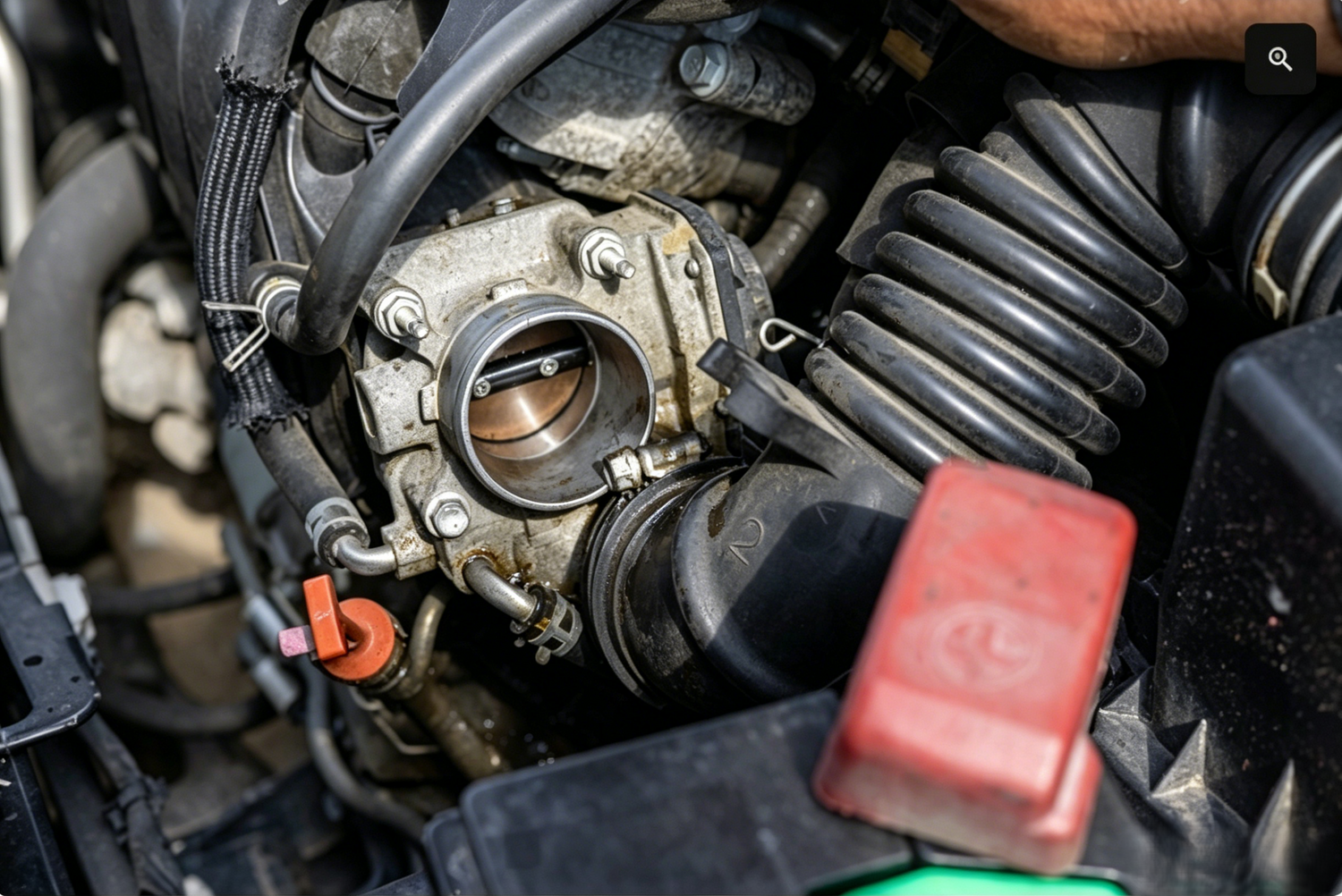
A throttle body controls how much air enters your engine. Think of it as the engine's "air valve."
Here's how it works:
- When you press the gas pedal, the throttle body opens a round butterfly valve.
- The more it opens, the more air flows into the engine.
- The engine's computer adds the appropriate amount of fuel to match the extra air.
- More air + more fuel = more power and higher engine speed.
At idle, the throttle body is almost closed, letting only a small amount of air through to keep the engine running.
Common Symptoms of a Dirty Throttle Body
A dirty throttle body restricts airflow into the engine, disrupting the air-fuel mixture and reducing engine performance. Carbon deposits, oil residue, and dirt can accumulate around the throttle plate over time, leading to a variety of drivability issues.
Here are the most common symptoms of a dirty throttle body:
| Symptom | What You'll Notice | Why It Happens |
|---|---|---|
| Rough Idle | Engine shakes, vibrates, or idles unevenly | Carbon buildup prevents the throttle plate from maintaining proper airflow at idle. |
| High or Low Idle RPM | Idle speed is unusually high, too low, or fluctuates | The engine control module (ECM) struggles to compensate for restricted airflow. |
| Poor Acceleration | Vehicle hesitates or responds slowly when pressing the accelerator | Limited airflow reduces engine power and throttle response. |
| Engine Stalling | Engine stalls shortly after starting or while idling | Insufficient air enters the engine, especially at low RPM. |
| Hard Starting | Engine takes longer than normal to start | Incorrect air intake affects the fuel-air mixture during startup. |
| Reduced Fuel Economy | More frequent trips to the gas station | The ECM may inject extra fuel to compensate for improper airflow. |
| Check Engine Light | The Check Engine Light turns on | The ECM detects abnormal airflow or throttle position readings and stores a diagnostic trouble code (DTC). |
| Jerky or Surging Driving | Vehicle surges, bucks, or feels inconsistent while driving | Inconsistent airflow causes unstable engine performance. |
How to Tell from Throttle Body Symptoms Whether It Is Dirty or Damaged
The symptoms of a dirty throttle body and a damaged throttle body are very similar. Before taking action, you should first identify the following key signs:
1. Rough Idle
- Symptom:When pressing the accelerator, engine RPM cannot remain stable, and engine shaking may occur.
- Possibility of Dirt: Carbon deposits or grime restrict airflow, causing unstable idle.
- Possibility of Damage: A faulty Throttle Position Sensor (TPS) causes incorrect airflow calculations.
2. Delayed Acceleration
- Symptom: When throttle response is slow, the vehicle cannot accelerate quickly.
- Possibility of Dirt: Carbon buildup affects smooth airflow, causing delayed acceleration.
- Possibility of Damage: Throttle motor or control circuit failure.
3. Check Engine Light (CEL)
- Symptom: If the check engine light comes on, it usually indicates an electrical fault or sensor problem.
- Possibility of Dirt: In some cases, carbon buildup may also cause abnormal sensor data.
- Possibility of Damage: Failure in the throttle control system or sensors.
4. Limp Mode
- Symptom: The vehicle enters reduced-power mode and cannot accelerate normally.
- Possibility of Damage: Strongly indicates the need for immediate diagnostic scanning and may be a serious electronic system fault.
👉 Related Reading: How Do I Reset My Throttle Body with OBD2 Scanner?
How to Use Foxwell Live Data to Tell “Dirty” from “Bad”
If you want to know whether the throttle body is faulty or dirty, you need to use a diagnostic scanner, enter live data mode, and make decisions based on real-time data. Foxwell products are recommended here.
1. Scan Fault Codes
- Connect the device and check for codes such as P0507 (Idle Speed Higher Than Expected) or P2111 (Throttle Actuator Control Fault).
- After clearing the codes, monitor whether they return.
2. Check TPS Percentage
- Observe whether the opening percentage of the Throttle Position Sensor (TPS) changes smoothly as accelerator pedal pressure changes
👉 Related Reading: What Does TP Mean on an OBD2 Scanner?
3. Smoothness Test
- Observe data changes while pressing the accelerator pedal and determine whether they are smooth.
- Indicates Dirt: TPS values should change smoothly.
- Indicates Damage: If the value jumps or sticks while pressing the pedal, physical damage is far more likely than carbon buildup.
Using this data, you can accurately determine whether the throttle body is dirty or damaged.
Quick Diagnostic Decision Matrix
Here is a quick reference chart for you:
| Symptoms | Possibility: Carbon Buildup | Possibility: Electronic Failure | Foxwell Diagnostic Suggestion |
|---|---|---|---|
| Slight rough idle | 🟢 High | 🟡 Low | Clean and perform Idle Relearn |
| Limp Mode | 🔴 Low | 🟢 High | Check TPS sensor live data |
| Acceleration lag | 🟢 Medium | 🟢 Medium | Compare pedal position with throttle opening |
| P0121 / P0507 fault codes | 🟢 High | 🟢 High | Clear codes and watch for jumping values |
This is a comparison chart of a dirty vs. a bad throttle body.

Based on diagnostic results from tools such as the Foxwell NT710, you can accurately choose the right repair plan and greatly reduce expenses.
Dirty vs Faulty Throttle Body
Not every throttle body problem means the unit needs to be replaced. In many cases, carbon buildup can be cleaned, while mechanical or electronic failures require replacement.
| Feature | Dirty Throttle Body | Faulty Throttle Body |
|---|---|---|
| Cause | Carbon buildup | Mechanical or electronic failure |
| Rough idle | Yes | Yes |
| Loss of power | Moderate | Severe |
| Cleaning fixes it | Usually | No |
| Replacement required | Rarely | Often |
| Check Engine Light | Sometimes | Usually |
| Electronic throttle faults | No | Yes |
If cleaning does not restore normal throttle operation or diagnostic trouble codes return, further testing or replacement may be necessary.
Repair Decision: Clean or Replace?
1. Cleaning Option
- Cost: About $10 - $50
- If the issue is only dirt or carbon buildup, cleaning is usually the most cost-effective solution.
2. Replacement Option
- Cost: About $250 - $800
- If TPS values are unstable or fault codes indicate physical/electrical failure, the throttle body must be replaced.
Using live data can help you avoid unnecessary replacement costs and ensure a more economical repair decision.
How to Perform a Throttle Body Relearn (With or Without a Scanner)
After cleaning or replacing a throttle body, some vehicles require a throttle body relearn procedure to restore normal idle speed and throttle response. During the relearn process, the ECU recalibrates the throttle plate position and stores the correct operating values.
There are two common ways to perform a throttle body relearn:
-
Manual Relearn: Some vehicles allow the relearn process by following a specific ignition and idle procedure. The exact steps vary by manufacturer.
-
Scanner Relearn: Many modern vehicles require a diagnostic scanner to complete the relearn electronically. A compatible scan tool performs the throttle adaptation procedure through the vehicle's ECU, providing a faster and more reliable result.
If rough idle, hesitation, or a Check Engine Light remains after cleaning, performing a throttle body relearn should be one of the first diagnostic steps.
Conclusion
Recognizing and dealing with throttle body problems early can not only improve driving performance, but also save expensive repair costs.
With Foxwell diagnostic tools, you can more quickly and accurately identify the root cause of throttle body issues and make the right repair decision.
Regular inspection and maintenance of the throttle body, combined with professional live data monitoring equipment, can help keep your vehicle in good condition long-term and prevent future problems.
Frequently Asked Questions (FAQs)
1. How long can you drive with a bad throttle body?
You might be wondering—is it safe to drive with a bad throttle body? The quick answer is no.Once it starts showing signs of failure or clogging, you should address the issue immediately. Otherwise, the vehicle may stall or fail to accelerate, creating a safety hazard.
2. What does a bad throttle body sound like?
If your throttle body actuator is failing, you may hear unusual sounds, especially when starting the engine or pressing the accelerator.Listen for whining, humming, or clicking sounds, as these may indicate problems with the actuator or related components.
3. How often does a throttle body need to be cleaned?
A common recommendation is every 75,000 miles, but it can vary. Vehicles that are not driven often or for long distances may never need cleaning. Smaller vehicles and hybrids can often wait until 100,000 miles.
4.Is it safe to drive with a bad throttle body?
No, it is not safe to drive with a bad throttle body. A failing throttle body can reduce engine performance, cause unstable idling, trigger Limp Mode, or stall the engine. Driving with these symptoms increases the risk of unsafe vehicle operation and can lead to additional engine or electronic throttle system problems.
5.can a dirty throttle body cause loss of power
Yes. A dirty throttle body reduces engine power by restricting airflow into the engine. As carbon and other deposits build up around the throttle plate, the ECU receives inaccurate airflow information and adjusts fuel delivery accordingly. This results in sluggish acceleration, reduced throttle response, and noticeable power loss.
6.Can I perform throttle body adaptation on a MINI Cooper myself?
Yes. Many MINI and BMW models require a throttle body adaptation after the throttle body has been cleaned or replaced. Using a compatible diagnostic scanner is the most reliable way to complete the adaptation procedure and restore normal throttle operation. Before performing the adaptation, make sure the throttle body is clean and any related fault codes have been cleared.


Leave a comment
This site is protected by hCaptcha and the hCaptcha Privacy Policy and Terms of Service apply.