

When a Check Engine Light Doesn’t Tell the Whole Story

A few months ago, a customer brought in a 2003 Chevy Astro van with a rough idle and a stubborn check engine light. The code pointed toward a lean condition, but nothing obvious stood out. No broken hoses, no loose clamps, nothing that jumped out visually.
If you’ve dealt with older vehicles long enough, you know what that usually means: a vacuum leak hiding somewhere you can’t see.
That’s when I pulled out the Foxwell ST203 automotive smoke machine.
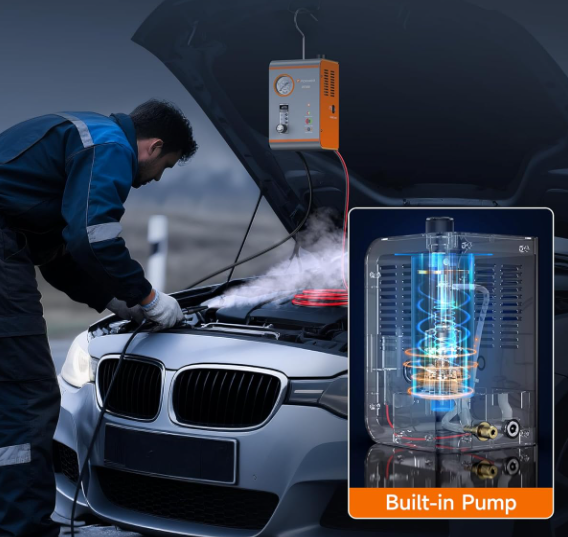
I’ve used smoke testers before, but the ST203 was interesting because it combines a built-in air pump and dual testing modes, meaning I didn’t need to drag out a compressor or extra equipment.
First Impressions and Setup
The first thing I noticed about the Foxwell ST203 car smoke tester is how compact it is. At about 5.5 pounds, it’s easy to move around the shop or even take on mobile repair calls.
Setup is simple:
- Connect the power clamps to the car battery
- Add smoke fluid
- Attach the smoke hose to the system you want to test
That’s it.
Unlike older smoke machines I’ve used, the ST203 doesn’t need an external air compressor. The built-in air pump handles everything internally, which makes the whole setup faster and cleaner.
Within about 10 seconds, the machine was already producing smoke. That alone saves a lot of time during diagnostics.
Dual Mode Testing: Why It’s Actually Useful
One feature that immediately stood out to me on the Foxwell ST203 Automotive Smoke Machine Leak Detector is its dual testing modes.
Most smoke leak detectors I’ve used only do one thing: produce smoke and push it through the system. It works, but sometimes it feels like overkill when you just want to know whether a leak exists in the first place.
The ST203 gives you two simple options:
-
Air Mode (green)
This mode pushes pressurized air through the system without smoke. By observing the built-in pressure gauge and dynamic flow meter, you can immediately confirm if there’s a leak and gauge its size before wasting any smoke fluid. If the gauge drops or the flow meter shows high activity, you have 100% confirmation of a leak.
-
Smoke Mode (red)
Once a leak is confirmed, switching to Smoke Mode fills the system with visible smoke, making it easy to pinpoint the exact location of the leak.

When I first saw this, I assumed it was mostly a marketing feature. But after using it a few times, the logic actually made sense.
Air Mode is great when you just want a quick answer to the question:
“Is there a leak somewhere in this system?”
If the pressure drops quickly, that’s your confirmation.
Then switching to Smoke Mode lets you visually track where the leak is coming from. During one test on an EVAP system, I used Air Mode first and saw the pressure drop almost immediately. After switching to Smoke Mode, smoke appeared near a loose hose connection under the intake; problem found.
This two-step process ended up saving time compared to running smoke tests from the start. Air Mode confirms the issue quickly, while Smoke Mode handles the precise diagnosis.
Compared to single-mode smoke machines, it’s a small feature, but one that actually makes the testing process faster and a bit more efficient.
Real World Test: Finding a Hidden Vacuum Leak
Back to that Chevy Astro.
I connected the ST203 to the intake system and started with Air Mode. The pressure gauge immediately showed a drop, which confirmed what I suspected; there was definitely a leak.
Then I switched to Smoke Mode.
Within seconds, thin white smoke started creeping out from behind the intake manifold. After a closer look, I found a cracked vacuum hose buried behind a wiring harness.
It was the kind of leak you’d probably never spot visually. Without a smoke tester, I might have spent an hour chasing that problem. With the ST203, it took maybe five minutes.
As many Astro van owners have discovered—including other DIYers in the community—this specific vehicle is notorious for rotted vacuum hoses that disable the HVAC doors. Using a smoke machine like the ST203 isn't just an option; it's often the only way to save hours of blind guessing behind that cramped engine doghouse.
Built-In Pressure Gauge and Flow Meter
Another feature I ended up appreciating more than expected is the pressure gauge and dynamic flow meter.
These tools help you understand how serious a leak actually is.
For example:
- Stable pressure usually means the system is sealed
- Slow pressure drop points to a small leak
- Rapid pressure drop usually means a major leak or disconnected hose
The adjustable smoke output knob also helps when working with different systems.
Some systems, like EVAP, require gentle pressure, while intake or turbo systems can handle more flow. Having control over that makes the ST203 feel more precise than many entry-level smoke machines.
Another Job: HVAC Vacuum Issue
Another time the ST203 came in handy was on a vehicle with HVAC airflow problems.
The owner complained that air was always stuck blowing through the defrost vents no matter what setting they selected. That’s usually a sign of vacuum actuator problems.
Using the car vacuum smoke tester, I ran smoke through the HVAC vacuum lines. Within seconds, smoke started leaking from a tiny crack in one of the hoses near the firewall.
Once the hose was replaced, the HVAC system worked perfectly again.
Where the ST203 Really Helps in a Shop
After using the tool for a while, I realized the ST203 is especially helpful for diagnosing leaks in systems like:
- EVAP systems
- Intake manifolds
- Turbo piping
- Vacuum hoses
- Fuel tank systems
- EGR circuits
- Crankcase ventilation
- Cabin air sealing
Before using smoke testing regularly, diagnosing these kinds of issues often involved a lot of guessing. With smoke, the leak literally reveals itself visually.
Comparing It With the Foxwell SD201
Foxwell also offers the SD201 smoke machine, which is a simpler unit. After trying both, the ST203 feels like a noticeable upgrade.
The biggest improvements are:
- Dual mode testing
- faster smoke generation
- better leak monitoring
- more precise flow control
In practice, the ST203 just feels smarter and quicker to work with.


Is the Built-In Air Pump Worth It?
This is one of the most common questions buyers ask. After using the ST203 in real situations, I’d say absolutely.
Not needing an external compressor makes the tool:
- easier to set up
- more portable
- faster to start using
For DIY users or smaller garages without large compressors, that feature alone makes the tool much more practical.
A Few Minor Drawbacks
Even though I’ve had good experiences with the ST203, there are a couple small things worth mentioning.
First, smoke machines always require proper sealing of the system, which means you sometimes need to experiment with the included adapters to block off lines.
Second, like any smoke tester, it’s strictly a diagnostic tool. It helps you find leaks, but you still need to repair them afterward.
Neither of these issues are dealbreakers, but they’re part of using any smoke machine.
Is $200 a Good Price for This Tool?
Considering what the ST203 offers, the $200 price point is pretty reasonable. Professional shop smoke machines can cost $500 to $1,500, sometimes more.
For the price, you’re getting:
- dual-mode testing
- built-in air pump
- pressure monitoring
- adjustable smoke output
- portability
For most DIYers and even many professional shops, that’s more than enough capability.
Who This Tool Is Best For
After spending time using the ST203, I’d say it’s best suited for:
- Professional mechanics: who want faster leak diagnostics.
- Small repair shops: that need a reliable smoke tester without spending thousands.
- DIY enthusiasts: who want a real diagnostic tool rather than guessing at vacuum leaks.
Final Thoughts
After using the Foxwell ST203 automotive smoke machine, it’s easy to see why smoke testers have become such an important diagnostic tool.
The combination of dual testing modes, built-in air pump, and real-time leak monitoring makes the process of finding vacuum or EVAP leaks much faster and more precise.
Instead of guessing where the problem might be, the leak becomes visible within seconds.
For both professional mechanics and serious DIY enthusiasts, the Foxwell ST203 car smoke tester is one of those tools that quickly proves its value the first time it helps solve a difficult diagnostic problem.
Related reading: Foxwell SD201 Review
FAQs
Do I need a separate air compressor to use this machine?
No. One of the Foxwell ST203's most-praised features is its built-in air pump. You simply connect it to your car's 12V battery and add smoke fluid. It generates its own pressure and smoke independently, making it perfect for mobile repairs and home garages without large shop air.
What automotive systems can this machine test?
It’s incredibly versatile. Based on real user feedback, it effectively diagnoses Intake Manifolds and EVAP systems, as well as vacuum lines, exhaust systems, and even HVAC vacuum-actuated doors inside the cabin.
What should I watch out for when adding smoke fluid?
Be sure to monitor the Sight Gauge on the side carefully. The volume between the bottom of the gauge and the "MAX" line is quite small (about one teaspoon), and it can overflow if filled too quickly. It’s best to add fluid in small increments. If you do overfill, drain the excess before turning it on to avoid a mess at the nozzle.
Is the power cord long enough to test the rear exhaust system?
Some users find the included 12V cord a bit short for reaching the rear of longer vehicles. Pro Tip: If you need more mobility, follow the lead of seasoned DIYers and use a spare 12V vehicle battery or a 12V DC power adapter to power the unit locally.
How durable is it? Is it suitable for a professional shop?
While positioned as a high-value DIY/semi-pro tool, many full-time technicians (including BMW specialists) report that it performs as well as commercial units costing $500–$1,500. It features a solid metal body, but because it contains precision internal components, users recommend placing it on a flat surface or using the integrated hook to prevent accidental drops.
How should I store all the included accessories?
The ST203 comes with an excellent assortment of adapters and red plugs. Since it doesn’t include a dedicated carrying case, we recommend using a small tool bag or organizer box to keep the accessories together, especially the smaller plugs which can be easily misplaced.



Leave a comment
This site is protected by hCaptcha and the hCaptcha Privacy Policy and Terms of Service apply.