

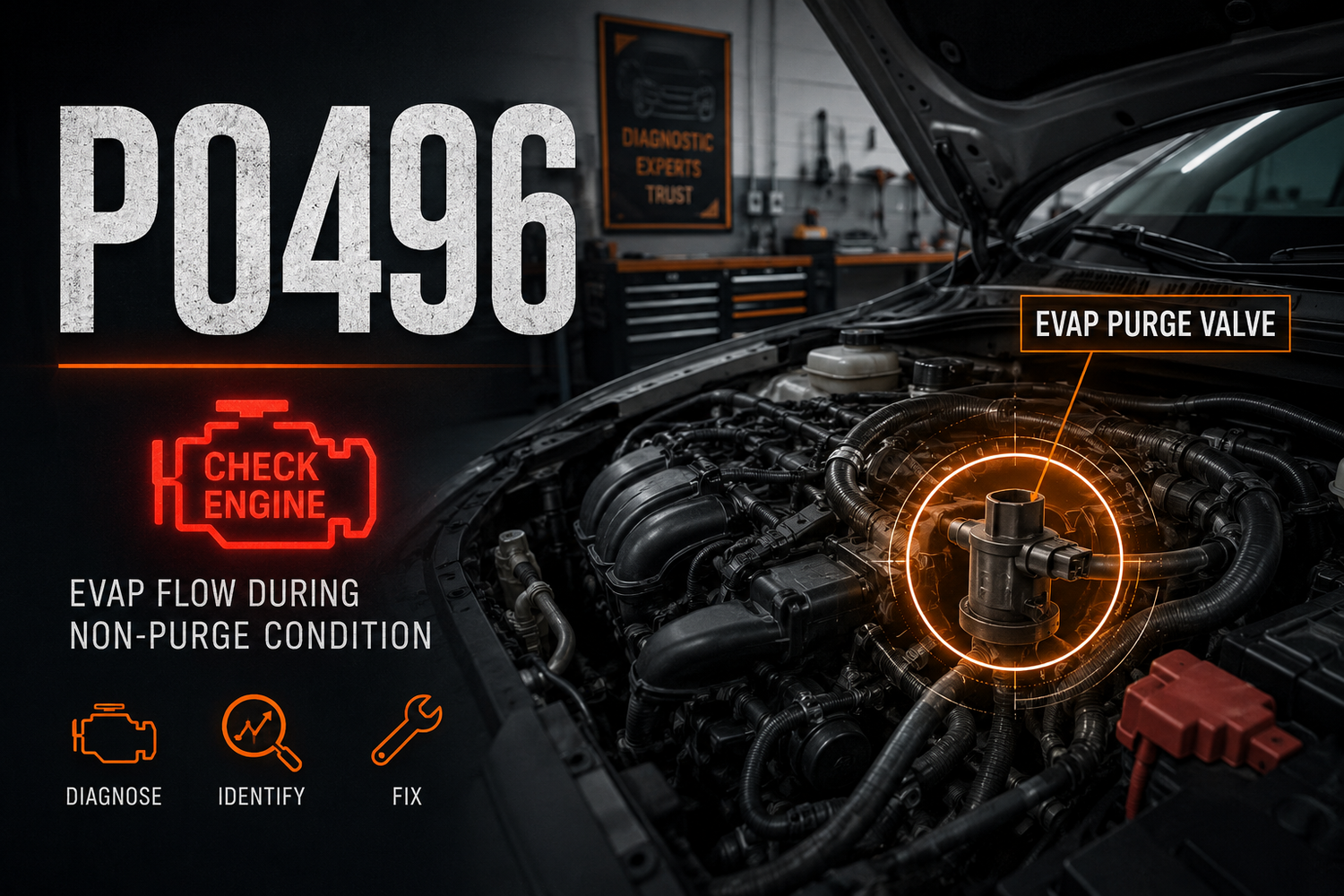
Your check engine light is on, your car is hard to start after filling up, and a scan tool is showing P0496. Before you spend money at a shop, read this. Most P0496 repairs cost under $200 — if you diagnose it correctly first.
What Does P0496 Mean?
P0496 is an OBD-II diagnostic trouble code (DTC) defined as "EVAP Flow During a Non-Purge Condition."
To understand it, you need to know how your EVAP system works. Your vehicle's Evaporative Emission Control (EVAP) system exists for one reason: to stop raw fuel vapors from escaping the gas tank into the atmosphere. Instead of venting those vapors, the system captures them inside a charcoal canister. When the engine is ready — typically at normal operating temperature and speed — the purge valve opens, and the intake manifold's vacuum draws those stored vapors into the engine to be burned during normal combustion.
The key phrase is "when the engine is ready." The Engine Control Module (ECM) or Powertrain Control Module (PCM) tightly controls when purging happens. It does this by commanding the EVAP canister purge solenoid valve closed and monitoring the Fuel Tank Pressure (FTP) sensor. If that sensor detects a vacuum building in the EVAP system when the purge valve is supposed to be shut, it means vapors are flowing when they shouldn't be. The ECM registers P0496 and illuminates the Check Engine Light (CEL).
In plain terms: your car is purging fuel vapors at the wrong time.
Note for Asian vehicle owners: On Mazda, Kia, Honda, Hyundai, and Acura vehicles, this code may be labeled "EVAP System High Purge Flow" — a slightly different name for the same problem. P0496 is also notably more common on GM vehicles (Chevy, GMC, Pontiac, Cadillac), but it applies to every OBD-II compliant vehicle on the road.
What Causes the P0496 Code?
There are eight main culprits. The most common is a faulty purge valve, but don't skip the cheaper checks first.
1. Gas Cap
It sounds too simple, but a loose, cracked, or missing gas cap is one of the most overlooked causes of EVAP-related codes. A faulty cap breaks the seal on the fuel system, allowing unintended vacuum to build. Always start here — it's a free check and a $10–$20 fix if the cap is the problem.
2. Purge Valve (Most Common Cause)
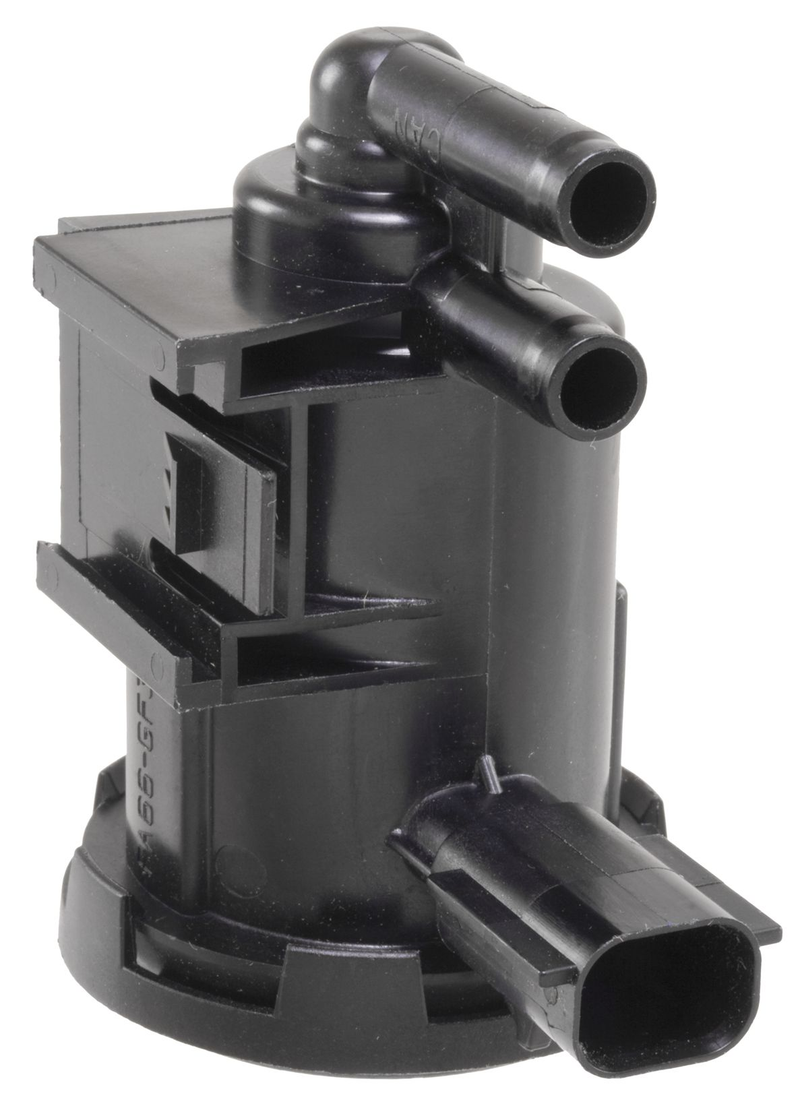
The canister purge valve (also called the purge solenoid or purge volume control valve) is the single most common cause of P0496. This electrically controlled solenoid valve opens and closes on command from the ECM. When it gets stuck open — due to wear, debris, or internal failure — fuel vapors continuously flow into the intake manifold even when the ECM has commanded the system closed. The result: an overly rich air-fuel mixture and a P0496 code.
On Chevy Silverado and Chevy Equinox models, a failed purge valve is the first suspect almost every technician checks. On Ford Bronco and Ford Maverick models, the purge valve (or vapor management valve) is similarly the most frequent culprit, and Ford has even issued Special Service Message SSM 50306 warning technicians not to replace the valve without proper diagnosis, as many returned parts are found fully functional.
3. Fuel Tank Pressure (FTP) Sensor
The FTP sensor is what the PCM uses to monitor EVAP system pressure. If this sensor is reading incorrectly — sending a false vacuum signal — the ECM will set P0496 even though nothing else is wrong. A bad FTP sensor is a less common but legitimate cause, particularly if you've already tested the purge valve and found nothing wrong.
4. Wiring and Connectors
Corroded, damaged, or shorted wiring to the purge valve or FTP sensor can cause erratic valve behavior or false sensor readings. Before replacing any parts, visually inspect the harness connectors at both components. A broken wire or corroded pin is an inexpensive fix that's easy to miss.
5. Vent Valve (EVAP Canister Vent Solenoid)
The vent valve controls airflow into the EVAP canister from the outside atmosphere. If it fails in a closed position, it can trap excessive vacuum in the system and trigger P0496. While less common than a failed purge valve, it's part of the same system and worth inspecting.
6. Charcoal Canister
The charcoal canister stores fuel vapors until the purge valve releases them. Over time, canisters can crack, become saturated (especially from overfilling the gas tank), or be contaminated with liquid fuel. A damaged canister disrupts EVAP system pressure balance and can contribute to P0496.
7. EVAP System Leak
Any crack or loose connection in the EVAP hoses, lines, or fittings can create an unintended vacuum pathway, confusing the FTP sensor and setting the code. A smoke test — pumping smoke into the sealed system and watching for it to escape — is the most reliable way to find these leaks.
8. Blown Fuse
Less common, but don't overlook it: a blown fuse in the circuit controlling the purge valve solenoid can cause the valve to lose power and behave erratically. Check the relevant fuse in your vehicle's fuse box before going further.
What Are the Symptoms of the P0496 Code?
P0496 is notorious for being "silent." The EVAP system is entirely closed, so there's nothing to hear, smell, or see under the hood in most cases. Here's what to watch for:
- Check Engine Light (CEL) illuminated — This is almost always the only symptom, and it will be there every time P0496 is active.
- Hard starting after refueling — Because the purge valve is stuck open, excess fuel vapor floods the intake when you start the car right after getting gas. This is the most distinctive real-world symptom and a strong indicator the purge valve is the culprit.
- Rough idle or erratic idle — An overly rich mixture from continuous purging can cause the engine to hunt for idle speed, particularly on GM vehicles like the Silverado and Equinox.
- Slightly reduced fuel economy — With vapors being purged at the wrong time, fuel metering is disrupted, and efficiency can drop marginally.
- Black smoke from the exhaust — In more severe cases, an extremely rich mixture can produce noticeable exhaust smoke.
- Failed emissions test — Even if you notice no drivability problems, P0496 will cause an automatic failure at any smog or emissions inspection.
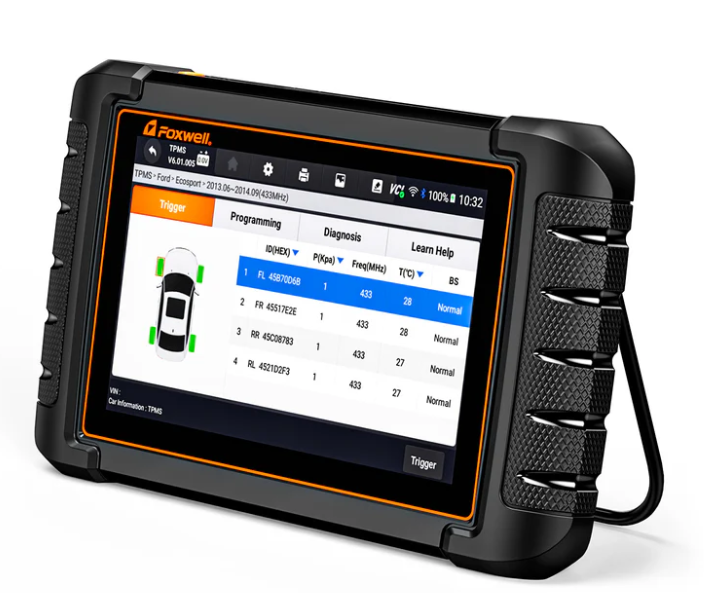
Pro tip: Don't rely on drivability symptoms alone to confirm this code. Use an OBD-II scanner like Foxwell NT301 to verify the DTC directly. If you clear the code and it returns within a drive cycle, the fault is genuine and active.
What Is the Danger of Ignoring It?
P0496 carries a low-to-moderate severity rating — your car will still drive, and the code won't cause immediate engine damage. But "safe to drive" doesn't mean "safe to ignore."
Here's what prolonged neglect can lead to:
- Automatic emissions test failure. In most states, an active P0496 code is an instant fail, regardless of whether you notice any symptoms.
- Catalytic converter damage. A constantly rich air-fuel mixture — caused by excess vapor entering the intake — can overheat and prematurely destroy the catalytic converter over time. Converter replacement runs $800–$2,000+.
- Masked serious faults. Your Check Engine Light is already on. If a more serious fault develops — misfires, O2 sensor failure, timing issues — you won't know because the CEL is already illuminated.
- Hard starts becoming no-starts. What starts as a difficult cold start after fueling can worsen until the vehicle won't start at the pump at all.
Bottom line: address P0496 within a reasonable timeframe. It's not an emergency, but it's not something to defer indefinitely.
How to Diagnose the P0496 Code
Proper diagnosis before replacing parts is critical. The single most common mistake technicians make is swapping out EVAP components — especially the purge valve — without confirming the fault. Ford's own SSM 50306 exists specifically because so many replaced purge valves turned out to be perfectly functional.
Here's the systematic approach:
Step 1: Scan and document the code. Connect an OBD-II scanner to the DLC port (usually under the dash, driver's side). Confirm P0496 is present. Note any freeze frame data — engine temp, RPM, load — that may indicate when the code set. The Foxwell NT809BT display full freeze frame data alongside live PIDs, which is helpful for EVAP diagnostics.
Step 2: Clear the code and test drive. Reset the code and drive the vehicle through a normal cycle (highway and city driving, ideally including a fuel stop). If the code returns, the fault is confirmed active. If it doesn't return immediately, it may have been a one-time event — monitor it over several drive cycles.
Step 3: Inspect the gas cap. Remove and inspect the cap for cracks, a damaged O-ring, or debris on the sealing surface. Reinstall firmly. A cap that only clicks once may not be sealing properly. If the cap is suspect, replace it ($10–$20) and re-test before going further.
Step 4: Perform a smoke test. A smoke machine connected to the EVAP system will reveal any leaks in hoses, fittings, the canister, or lines. This is the most efficient way to rule out physical leaks before condemning electrical components.
Step 5: Test the purge valve.
- Disconnect the purge valve. Check for charcoal particles in the valve — if present, the charcoal canister is contaminated and both components need replacement.
- Using a handheld vacuum pump, apply vacuum to the valve while it's closed (not energized). It should hold vacuum. If it bleeds down, the valve is leaking internally — replace it.
- Apply 12V power and ground to the valve terminals. It should open (you'll hear a click) and allow vacuum to pass. Remove power — it should close and hold vacuum again. Failure at any of these steps means replace the valve.
Step 6: Check the FTP sensor. With your scanner connected, monitor the fuel tank pressure sensor live data (PID). With the engine off and the gas cap installed, pressure should be near in H2O. During a commanded purge event (engine warm, cruising speed), you should see vacuum build. If the sensor reads erratically or doesn't respond, inspect its wiring and connector before replacing the sensor itself.
Step 7: Inspect wiring and fuses. Check the fuse(s) for the EVAP purge control circuit. Inspect the wiring harness and connectors at the purge valve and FTP sensor for corrosion, broken pins, or chafed insulation.
You can also watch the video: P0496 GM 3.6L - Diagnose and Fix in 3 Minutes
How to Fix the P0496 Code
Once you've identified the cause, here are the fixes in order of likelihood:
Tighten or replace the gas cap — Free to $20. Do this first.
Replace the purge valve — The most common fix. Parts cost $15–$60 for most domestic vehicles; OEM replacements for Ford run $50–$200. On most GM models, the valve is accessible on top of the engine and replacement is a 15–20 minute job requiring only basic hand tools: locate the valve, disconnect the electrical connector and two EVAP hoses, unclip or unbolt the valve, install the new one, reconnect everything, and clear the code.
Repair EVAP system hoses or fittings — If the smoke test reveals a leak, repair or replace the damaged section of hose. Hose and fittings are inexpensive; the labor is minimal if accessible.
Replace the FTP sensor — If the sensor is reading incorrectly, replacement costs $30–$80 for parts on most vehicles. Inspect wiring first.
Replace the charcoal canister — If contaminated or cracked, a new canister runs $50–$200 depending on vehicle. Always replace the purge valve simultaneously if canister contamination is found.
Repair wiring — Corroded connectors, broken wires, or blown fuses are inexpensive to address if you can locate them.
After any repair, clear the DTC with your scanner and perform a full drive cycle to verify the code does not return.
GM owners, check your warranty: For certain 2019–2024 Cadillac XT4 models, GM has issued Special Coverage Programs N202324990 and N242441120, extending warranty coverage on EVAP purge pump repairs to 15 years/150,000 miles. Check with your dealer using your VIN before paying out of pocket.
How to Replace the Fuel Tank Pressure Sensor
If diagnostics point to the FTP sensor, here's the general replacement procedure (steps vary by vehicle; always consult your service manual):
- Safety first: Relieve fuel system pressure and disconnect the negative battery cable.
- Locate the sensor: The FTP sensor is typically mounted on or near the fuel tank or charcoal canister. On many GM platforms, it's on top of the fuel pump module.
- Disconnect the electrical connector: Press the tab and pull the connector free.
- Remove the sensor: On most applications, the sensor twists out with a quarter-turn (bayonet mount) or is held by a single bolt. Use a fuel line disconnect tool if needed for integrated sensor/line assemblies.
- Install the new sensor: Transfer any O-rings from the old sensor, or use the new ones supplied with the part. Install and torque to spec.
- Reconnect the battery and connector, clear codes, and verify with a scan tool that FTP sensor PIDs read correctly at idle and during a commanded purge event.
Where to Get Replacement Parts for Your Vehicle
1.For OEM-quality purge valves, FTP sensors, and related EVAP components, check your dealership parts counter (most reliable for fit/finish), major auto parts retailers like AutoZone, O'Reilly, and RockAuto, or manufacturer-direct sources for your specific make. Always verify the part number against your VIN — purge valve locations and assemblies differ significantly between engine variants, as Ford Maverick owners with the 2.0L EcoBoost versus the 2.5L Hybrid can attest.
2.For diagnosis, an OBD-II scanner with live data capability is essential. The Foxwell NT809BT provides real-time EVAP system PIDs — including fuel tank pressure sensor readings and purge valve command status — which allows you to confirm the fault before buying any parts. A basic code reader that only shows the DTC number isn't sufficient for EVAP diagnosis.
How Difficult Is It to Diagnose and Fix a P0496 Code?
Diagnosis difficulty: Moderate. You need more than a basic code reader — live data capability (FTP sensor PIDs, purge valve commanded state) is necessary for accurate diagnosis. A smoke machine, while not strictly required, dramatically speeds up leak detection. If you're comfortable using a scan tool and doing basic component testing with a multimeter and vacuum pump, this is within DIY reach.
Repair difficulty: Easy to Moderate, depending on the root cause:
| Repair | DIY Difficulty | Estimated Cost (Parts + Labor) |
|---|---|---|
| Gas cap replacement | Very Easy | $10–$20 |
| Purge valve replacement | Easy | $150–$300 |
| EVAP hose repair | Easy–Moderate | $20–$150 |
| FTP sensor replacement | Moderate | $80–$200 |
| Charcoal canister replacement | Moderate | $150–$400 |
| Full EVAP system diagnosis (shop) | — | $100–$200 diagnostic fee |
Total repair cost across all scenarios typically falls between $100 and $500, with the purge valve fix on the low end and more complex canister/sensor repairs toward the higher end.
P0496 by Vehicle Make
P0496 is a universal OBD-II code, but behavior, common causes, and part locations vary by make:
| Vehicle | Common Cause | Notes |
|---|---|---|
| Chevy Silverado / GMC Sierra | Purge valve stuck open | Often accompanied by erratic idle after fueling; valve typically on engine top |
| Chevy Equinox / GMC Terrain | Purge valve; PCM (rare) | Erratic idle is characteristic; easy DIY purge valve swap |
| Chevy Cruze | Purge solenoid | Located on engine, 3-clip removal, ~$25 part |
| Cadillac XT4 | EVAP purge pump | May be covered under GM Special Coverage N202324990 / N242441120 |
| Ford Bronco | Canister purge valve stuck open | 15-min DIY; check Ford SSM 50306 before replacing |
| Ford Maverick | Purge valve; location varies by engine | 2.0L EcoBoost vs. 2.5L Hybrid have different valve locations and assemblies |
| Kia / Hyundai | Purge flow sensor; EVAP system leaks | Code labeled "EVAP System High Purge Flow" |
| Mazda / Honda / Acura | Purge flow sensor; stuck purge valve | Same alternate label as Kia/Hyundai |
"Non-Purge Condition" and "Flow" Explained
These two terms in the code definition are worth unpacking, because they clarify exactly what the system is detecting.
"Non-Purge Condition" refers to the operating state where the ECM has commanded the EVAP system to be sealed — the purge valve is closed, no vapor transfer is supposed to be occurring. This typically includes cold engine operation, idle, and deceleration phases.
"Flow" in this context means the FTP sensor is detecting a vacuum forming in the sealed system — evidence that vapors are in fact moving (flowing) from the canister toward the engine even though the purge valve was commanded closed.
Put together: the system is detecting vapor flow (evidence: building vacuum in the tank) during a phase when the ECM explicitly told everything to stop. That contradiction triggers the code. The root cause is almost always something that's physically bypassing the closed command — a stuck-open valve being the most common example.
Preventing P0496: Maintenance Tips
P0496 is largely preventable with routine attention to a few things:
- Don't top off your tank. Overfilling forces liquid fuel into the charcoal canister, saturating it and shortening its life considerably. Stop fueling when the pump clicks off automatically.
- Inspect your gas cap regularly. A worn O-ring is easy to miss but causes real problems. Replace the cap every few years or whenever you notice it doesn't seal firmly.
- Address rough idle or hard starts promptly. These are often early signs of a purge valve beginning to fail — catching it early means a $20–$40 part rather than a cascade of EVAP faults.
- Use an OBD-II scanner for regular health checks. Pending codes — faults the ECM has detected but not yet confirmed — show up before the check engine light triggers. Catching a pending P0496 early means you can verify the gas cap or run a purge valve test before the code becomes confirmed and the light comes on.
- Keep EVAP hoses and lines inspected. During oil changes, have the EVAP hose routing visually inspected for cracking or loose connections, particularly if you're in a region with extreme temperature swings.
Conclusion
P0496 — EVAP Flow During a Non-Purge Condition — is one of the most common EVAP-related codes you'll encounter, and it's especially prevalent in GM vehicles. The underlying message is consistent: fuel vapors are entering the intake when the ECM hasn't asked for them, almost always because a purge valve is stuck open, a gas cap isn't sealing, or there's a leak somewhere in the EVAP system.
The good news: with a capable OBD-II scanner and a systematic approach, this is a code you can diagnose accurately and — in most cases — fix yourself. The purge valve on a Chevy Cruze is a 15-minute, $25 job. Even on more complex platforms, total repair costs rarely exceed $500.
What you should not do is ignore it indefinitely, guess at the cause and start swapping parts, or clear the code without identifying the underlying fault. Proper diagnosis — starting with the gas cap, running a smoke test for leaks, and testing the purge valve with a vacuum pump — will get you to the right fix the first time.
FAQ
1. Can I replace a purge valve myself?
Yes, on most vehicles the purge valve is accessible in the engine bay, requires only basic hand tools (screwdrivers, pliers, socket set), and can be replaced in 15–30 minutes. On some models — like certain Ford Maverick hybrid configurations — the valve is part of a larger tube assembly and may require more disassembly. Confirm the location for your specific vehicle before starting.
2. How long does it take to fix a purge valve?
For most GM and Ford vehicles where the valve is on top of the engine, replacement takes 15–30 minutes for a DIYer. At a shop, the labor charge is typically 0.5–1.0 hours.
3. How much does it cost to fix a P0496 code?
Total cost depends on the root cause. Replacing a gas cap costs $10–$20. A purge valve replacement runs $150–$300 including parts and labor. More complex repairs (FTP sensor, charcoal canister, EVAP hose repair) typically fall in the $150–$650 range. Diagnostic fees at a shop run $100–$200 and are often applied toward the repair.
4. Can a bad gas cap cause P0496?
Yes. While it's not the most common cause, a loose, cracked, or worn gas cap breaks the seal on the EVAP system and can allow unintended vacuum to form, triggering P0496. Always check the gas cap first — it's the cheapest and easiest item to rule out.
5. Can you clean a purge valve without removing it?
Yes, you can clean an EVAP purge valve without fully removing it from the car, but you will need to disconnect at least one of the hoses. Because it is a delicate electrical and mechanical part, spraying cleaner into an entirely connected valve will push debris further into your engine or charcoal canister.
6. What causes a P0496 code after replacing the purge valve?
If P0496 returns after replacing the purge valve, consider: (1) the new valve is also defective (rare but possible with low-quality aftermarket parts), (2) the actual cause was never the purge valve — check the FTP sensor, EVAP hoses for leaks (smoke test), and wiring, or (3) on Ford vehicles, verify using the FDRS scan tool per SSM 50306 before condemning the new part. On GM vehicles, also inspect the charcoal canister and vent valve.
7. Which vehicles commonly get P0496?
P0496 is most prevalent in GM vehicles — Chevy Silverado, Equinox, Cruze, Malibu, Traverse, and their GMC and Cadillac counterparts. It also appears frequently on Ford Bronco and Ford Maverick models. Among Asian brands, Kia, Hyundai, Mazda, Honda, and Acura all see P0496 (labeled "EVAP System High Purge Flow"), typically with a faulty purge flow sensor as a vehicle-specific cause.
8. Will a P0496 code clear itself?
No — not reliably. The ECM will only clear a stored DTC after a set number of consecutive drive cycles pass without the fault being detected again. If the underlying condition (stuck purge valve, loose gas cap, EVAP leak) is still present, the code will keep returning. The only way to permanently clear P0496 is to address the root cause and verify with a scanner that the code doesn't return across multiple drive cycles.

Leave a comment
This site is protected by hCaptcha and the hCaptcha Privacy Policy and Terms of Service apply.