

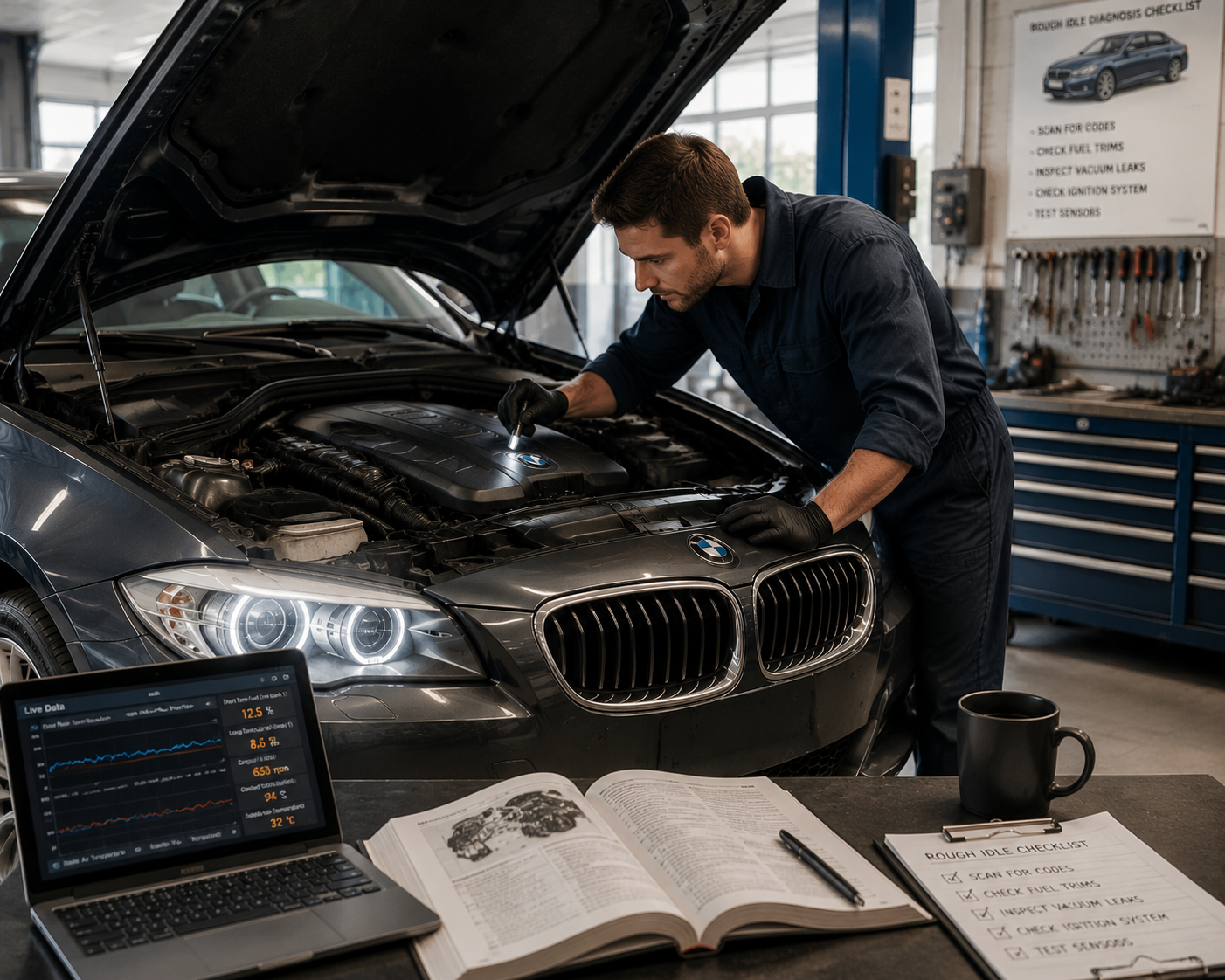
If you recently connected your diagnostic scanner to your BMW, navigated to the service menu, and executed a Clear Adaptations command—only to be greeted by a sputtering, shaking engine and a fluctuating RPM gauge—you are not alone.
This post-reset panic is one of the most frequent support tickets and forum threads across the BMW DIY community. The sudden rough idle, unresponsiveness, or even engine stalling can easily make you believe you’ve corrupted your Engine Control Unit (DME/ECU) or blown a critical sensor.
Here is the quick answer: Your DME is not broken, and your scan tool did not destroy your engine.
What you are experiencing is the temporary, uncalibrated baseline state of your engine’s digital brain. Below is a complete breakdown of why this happens, how to perform a proper DME re-learn procedure, and how to tell the difference between normal adaptation relearning and a real mechanical issue.
The Post-Reset Panic: Is Your BMW’s Engine Damaged?
When you fire up your BMW after resetting adaptations and the whole car starts vibrating at stoplights, your immediate reaction might be dread. You might even notice your live data displaying higher engine operating temperatures or erratic short-term fuel trims.
It is crucial to understand that clearing DME adaptations does not wipe your Engine Control Module's core flash memory or base maps.
The software that controls your fuel injection timing, ignition advance, and variable valve timing (VANOS) remains 100% intact. What you erased was merely the historical compensation data that your DME built over thousands of miles.
The sudden roughness is simply the engine running on factory-zero baseline parameters while attempting to calculate fuel and air delivery without its historical "memory."
Related Reading: How to Reset Your BMW's Adaptive Transmission in 30 Seconds
Why Does Clearing Adaptations Cause a Rough Idle?
To understand the cause of the rough idle, you have to look at how modern BMW Digital Motor Electronics (DME) operate.
As a BMW ages, several physical variables shift:
- Intake valves develop carbon buildup.
- Spark plugs and ignition coils gradually wear down.
- Throttle bodies collect carbon residue around the butterfly plate.
- Minor, undetected vacuum leaks (such as aging CCV hoses or valve cover gaskets) let unmetered air into the intake tract.
To keep the engine running smoothly despite these mechanical changes, the DME continuously adjusts its Fuel Trims (STFT/LTFT), Throttle Valve Angles, and Idle Speed Control Values. It "learns" to inject slightly more fuel or open the throttle a fraction of a millimeter wider to compensate for wear.
[ Factory Zero Baseline ] ---> Reset Adaptations erases learned compensations │ ▼ [ Engine Runs Too Lean/Rich ] ---> Engine shakes (Rough Idle) due to physical wear/leaks │ ▼ [ Driving & Idle Re-Learn ] ---> DME recalculates new trims to restore smooth idle
When you click Clear Adaptations on your scanner, you instantly wipe out all those learned compensations. The DME snaps back to factory-default baseline maps—as if the engine were brand-new off the assembly line. Because your physical engine parts still have wear and minor airflow discrepancies, the factory baseline causes an immediate, incorrect Air-Fuel Ratio (AFR), leading to misfires, RPM hunting, and a rough idle.
Related Reading: How and Why You Should Perform a Transmission Adaptation Reset
How to Fix It: Step-by-Step BMW DME Re-Learn Guide
If your engine is idling roughly after a reset, do not panic and do not keep clearing the memory over and over. The DME needs a structured Re-Learn Procedure to recalculate its parameters.
Step 1: Pre-Conditions Check
Before starting the re-learn process, ensure your ignition setup is correct:
- Turn off all heavy electrical loads (A/C, headlights, seat heaters, radio).
- Ensure your car battery is healthy. Voltage drops during adaptation relearning can corrupt the process.
Step 2: The Idle Re-Learn Process (10–15 Minutes)
- Start the engine without touching the gas pedal.
- Let the car sit in Park (P) or Neutral (N) at idle.
- Allow the engine to reach its normal operating coolant temperature (typically between 90℃ and 105℃ depending on your BMW engine model, such as the N52, N54, or M54).
- Do not touch the accelerator. As the engine warms up, you will hear the idle gradually smooth out as the DME recalculates its idle air control and short-term fuel trims.
Step 3: The Driving Cycle
Once the idle stabilizes at warm operating temperature:
- Drive the vehicle for 15 to 20 miles under mixed driving conditions.
- Include a combination of stop-and-go city driving and steady highway cruising at moderate throttle.
- Avoid wide-open throttle (WOT) or hard redline acceleration during the first 10 miles of relearning.
Normal Re-Learning Process vs. Real Mechanical Faults
How can you tell if the rough idle is just the DME relearning, or if an underlying mechanical issue was unmasked by the reset?
| Symptom / Test | Normal Adaptation Re-Learn | Underlying Mechanical Fault |
| Duration of Idle Shaking | Smooths out within 10–15 minutes of idle/driving. | Rough idle persists after 30+ minutes or days of driving. |
| Check Engine Light (MIL) | May flash temporarily or stay off. | Hard fault codes stored (e.g., P0300 Misfire, P0171/P0174 Lean Codes). |
| Coolant Temp / Overheating | Temp stays within normal operational threshold(95℃-108℃) | Coolant temp climbs steadily past 115℃+ (Air pockets or mechanical leak). |
Related Reading:P0174 Code: System Too Lean (Cylinder Bank 2) — Causes, Fixes, and Cost
Unmasking Hidden Vacuum Leaks
Often, a BMW runs fine prior to a reset because the DME was maxing out its Long-Term Fuel Trims (LTFT) to hide a vacuum leak. Once you clear adaptations, the LTFT drops to 0%. The engine immediately runs extremely lean, causing severe misfires.
If your idle does not smooth out after a drive, use your scanner to view Live Data for Short-Term Fuel Trims (STFT) and Long-Term Fuel Trims (LTFT). Trims spiking past +15% to +25% point directly to a physical intake leak, bad CCV valve, or failing Mass Air Flow (MAF) sensor—not a scanner error.
Pro Tip on Coolant Temperature: Clearing DME adaptations does not physically cause coolant leaks or cooling system failure. If you notice high coolant temperatures following a scan, check physical components—such as ensuring your coolant expansion tank cap is securely sealed or checking for air pockets in the cooling system.
Related Reading:Car Vacuum Leaks: Learn Symptoms, Causes & Save Big Today
Related Reading:Understanding Fuel Trims: A Comprehensive Guide
Take Control of Your BMW Diagnostics with Foxwell
Performing advanced dealer-level maintenance on a BMW requires hardware that communicates directly with proprietary BMW protocols (DME, EGS, ABS, and Body modules). Generic $20 OBD2 code readers can only read basic emission codes—they cannot execute targeted adaptation resets or monitor live BMW data streams.
To perform adaptation resets safely and accurately without guessing, having the right tool is essential:
- Foxwell NT710 for BMW: Designed specifically for BMW, Mini, and Rolls-Royce enthusiasts. The NT710 offers OE-level full-system diagnostics, bi-directional active testing, DME/EGS adaptation resets, battery registration, and ECU coding—all with lifetime free software updates.
- Foxwell NT809BT Multi-Brand Tablet: An advanced wireless diagnostic tablet featuring 30+ service reset functions, live data graphing, and full-system scanning for DIYers who maintain multiple car brands alongside their BMW.
Understanding how your BMW's DME adapts ensures you won't panic the next time you see a fluctuating RPM gauge after a service reset. Give the DME time to learn, monitor your live data, and let your diagnostic tools work for you.
FAQS
1. Is it okay to drive with a rough idle?
It depends on the cause. A mild rough idle may allow short-distance driving, but it should be diagnosed soon. If the vehicle has a flashing check engine light, severe shaking, loss of power, overheating, or unusual noises, stop driving and inspect it immediately.
Common causes include vacuum leaks, bad spark plugs, ignition problems, dirty throttle bodies, and fuel system issues. An OBD2 scanner can help identify related fault codes and engine data.
2. Why does my car idle rough but drive smoothly?
A car may idle rough but drive smoothly because idle conditions require the engine to maintain a very low and stable RPM. Small issues like a vacuum leak, dirty throttle body, worn spark plugs, ignition coil problems, or fuel mixture issues can be more noticeable at idle.
When driving, higher RPM and engine load can sometimes hide these problems.
3. What could be causing my BMW to idle roughly?
Common causes of BMW rough idle include:
- Vacuum leaks or PCV system problems
- Worn spark plugs or faulty ignition coils
- Dirty throttle body
- Fuel injector issues
- Variable valve timing (VANOS) problems
- Worn engine mounts
A BMW rough idle does not always mean engine failure. Reading fault codes and checking live data can help identify the actual cause.
4. How to tell if a BMW engine is bad?
A bad BMW engine usually shows more serious symptoms, such as:
- Persistent misfires
- Low compression
- Excessive oil consumption
- Blue exhaust smoke
- Knocking noises
- Overheating or coolant loss
A rough idle alone does not mean the engine is failing. Start with an OBD2 scan, then check ignition components, fuel system, and engine mechanical condition if needed.

Leave a comment
This site is protected by hCaptcha and the hCaptcha Privacy Policy and Terms of Service apply.