

Key Points
- Thermal cameras detect temperature differences, not faults directly
- Common automotive uses include overheating, electrical, and brake diagnostics
- Thermal imaging works best as a visual complement to OBD diagnostics
- Abnormal heat patterns help identify issues before fault codes appear
- Thermal management tools (like heat tapes and heaters) help prevent heat-related failures
What Is a Thermal Imaging Camera for Automotive Diagnostics?
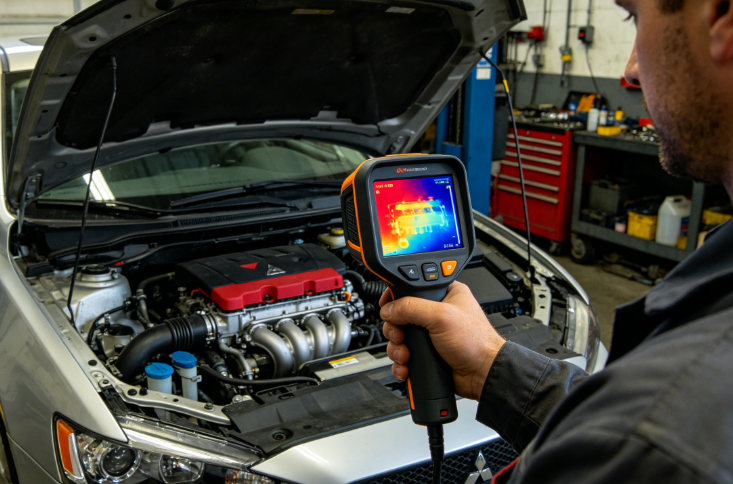
A thermal imaging camera for automotive diagnostics is a tool that detects infrared heat patterns to identify hidden issues in vehicle systems, such as overheating, electrical faults, and mechanical wear.
Thermal imaging has become one of the most effective ways to visually detect hidden problems in vehicles. Instead of relying only on error codes or guesswork, a thermal camera lets you see heat patterns—often revealing issues before they become serious failures.
It provides a fast, non-contact way to diagnose problems that are not visible to the naked eye.
What Problems Can Thermal Imaging Detect in Cars?
Thermal imaging doesn’t directly show the fault—it shows temperature anomalies, which point you to the hidden overheating, poor insulation, fluid issues and component failures that regular visual inspection cannot find. To better understand why thermal images can sometimes be misleading, see how thermal cameras work in automotive diagnostics.
1. Cooling System & Engine Block Issues
Heat is the biggest enemy of an engine, and thermal cameras can pinpoint where the cooling process is breaking down.
- Overheating cylinders, blocked radiators and clogged cooling lines
- Failed water pumps, weak thermostat performance
- Leaking coolant and hidden hot-spot engine heat loss
- Uneven exhaust manifold and catalytic converter overheating
Thermal cameras can also reveal indirect issues that are not immediately visible, such as airflow restrictions behind the grille. These cases are sometimes linked to faults like P059F (active grille shutter system failure), where the shutters fail to open or close properly.
2. Electrical System Faults
Electrical problems often generate resistance, and resistance generates heat.
- Overloaded wires, corroded connectors and high-resistance terminals
- Short circuits, faulty fuses and hot battery terminals
- Aging wiring harnesses with abnormal heat buildup
- Overheating alternators, starters and relay burnout risks
3. Braking & Suspension Components
Friction is the primary source of heat in moving parts.
- Sticking calipers, dragging brakes and uneven brake disc heat
- Failed wheel bearings with abnormal friction heat
- Uneven load and heat distribution on suspension parts
4. Climate Control (HVAC) Diagnostics
- Clogged heater cores, blocked AC evaporators
- Damaged door weatherstripping and air leakage
- Poor insulation, hidden water leaks and damp interior areas
5. Transmission and Drivetrain
- Transmission Overheating: You can scan the transmission cooler lines to ensure the fluid is being cooled properly.
- Differential Friction: Excessive heat in the differential can point to worn gears or low fluid levels.
6. Fluid Leaks & Body Hidden Issues
- Undetected oil, transmission fluid and coolant leaks
- Moisture buildup in hidden body panels, under carpets
- Rust hotspots and damaged underbody protective coating
7. Battery & Hybrid/EV Specific Faults
- Lithium battery cell overheating and unbalanced temperature
- Overheating high-voltage cables and charging system parts
- Weak battery modules with abnormal thermal signatures
Related Reading: Foxwell Thermal Camera RT100 FAQs: Everything You Want To Know
Thermal Imaging Cameras for Automotive Diagnostics (How It Works)
- Capture Infrared Heat Signals
Every mechanical, electrical and hydraulic part generates unique heat during operation.
The thermal camera’s infrared sensor detects subtle temperature changes that the human eye cannot see.
- Convert Heat to Visual Heat Mapping
Hot areas show warm tones like red and orange
Cold or low-efficiency parts appear in blue, purple or green.
- Locate Hidden Abnormalities
Unusual high heat means friction, overload, short circuits or blockages.
Unusual cold spots indicate clogs, leaks, low flow or failed component operation.
- Fast, Non‑contact Diagnosis
It works without disassembly, physical contact or stopping vehicle operation. Technicians scan engine bays, wiring, brakes, cooling systems and interior parts to complete quick fault detection.

Key Advantages for Automotive Use
- - Finds intermittent and hidden faults without teardown
- - Reduces diagnostic time and unnecessary part replacement
- - Safe for checking high‑voltage, overheating and high‑current components
- - Suitable for gas cars, hybrids and electric vehicle diagnostics
- -Compare components side-by-side
Thermal Testing vs Traditional Automotive Diagnostics
Automotive thermal testing refers to the process of using temperature-based analysis tools, such as thermal cameras, to evaluate vehicle performance, detect faults, and identify heat-related issues.
Thermal imaging is not a replacement for OBD2 tools—it’s a complementary testing method.
Thermal testing is fast, non-invasive, which is ideal for early detection and visual confirmation, while traditional diagnostics is basic, code-based, and only reacts to obvious vehicle problems, which provide data-level verification.
| Comparison Item | Thermal Imaging Testing | Traditional Automotive Diagnostics |
|---|---|---|
| Core Principle | Captures infrared heat, identifies faults via temperature differences | OBD2 code reading, visual check, manual measurement & disassembly |
| Detection Type | Finds hidden, early, non-code invisible faults | Only detects obvious failures with warning lights & fault codes |
| Inspection Way | Non-contact, no disassembly, non-destructive | Manual inspection, partial disassembly, physical contact |
| Diagnostic Speed | Fast, complete key area scanning in minutes | Time-consuming, slow troubleshooting |
| Early Warning | Supports pre-failure detection, avoids severe damage | Reactive, only works after parts fail or lights turn on |
| Main Test Targets | Wiring overheating, brake drag, clogging, leaks, moisture, battery abnormal heat | Engine codes, obvious mechanical damage, complete part failure |
| Skill Dependence | Low, intuitive heat map display | High, relies heavily on technician experience |
| Limitation | Affected by ambient temperature; cannot read DTC codes directly | Misses hidden internal & temperature-related abnormal issues |
Best Thermal Testing Methods for Automotive Components
Below are the most practical, widely used thermal testing methods for automotive parts, tailored to repair shops, DIY diagnostics, and regular vehicle thermal management checks.
| Thermal Testing Method | Core Principle | Best For | Application Scenario |
|---|---|---|---|
| Infrared Thermal Imaging (Passive Testing) | Detect surface temperature differences via thermal cameras during normal operation | Quick diagnostics, fault detection, non-invasive inspection | Real-world automotive repair (most common) |
| Heat Load Testing (Active Thermal Testing) | Apply controlled load/stress to components to observe heat behavior | Identifying overheating under real driving conditions | Manufacturing, engineering, professional diagnostics |
| Thermal Cycling Testing | Repeated heating & cooling to simulate long-term wear | Durability testing, material fatigue detection | Component manufacturing, quality control |
| Contact Temperature Measurement | Use thermocouples/sensors for precise temperature data | Accurate data validation, engineering-level diagnostics | R&D, professional engineering testing |
Real-World Automotive Thermal Testing Cases
Engine Overheating Detection
- Localized hotspots
- Cold spots in the radiator
- Uneven hose temperatures
This often indicates:Blocked coolant flow、Thermostat failure、Radiator inefficiency
Electrical Fault Detection
- Overheating connectors
- Failing relays
- High-resistance wiring
Brake System Inspection
- Brake caliper may be stuck
- Pad may be dragging
- Bearing may be failing
Exhaust System Faults
- Uneven temperature on catalytic converter
- Localized hotspots near manifold
- Cold spots in exhaust pipes
HVAC & Interior Performance
- Cold spots in heater core
- Hot zones in AC evaporator
- Temperature gaps around door seals
Fluid Leak & Moisture Detection
- Cool spots from coolant micro-leaks
- Warm patches from oil seepage
- Abnormal cold zones from trapped moisture
EV & Battery System Testing
- Isolated hotspots in battery modules
- Uneven temperature between cells
- Overheating high-voltage cables
Automotive Thermal Management and Heat Control Solutions
What Is Automotive Thermal Management?
Automotive thermal management refers to controlling heat generation, distribution, and dissipation within a vehicle.
Core Purposes
- Prevent engine overheating and excessive cold-start wear
- Stabilize temperature for electronics, wiring, and control modules
- Maintain consistent performance of brakes, transmission, and exhaust parts
- Optimize HVAC heating and cooling comfort for the cabin
- Protect EV/hybrid battery packs from overheating or thermal imbalance
- Improve fuel efficiency, reduce emissions, and extend component service life
Heat-Reflective Automotive Thermal Tapes (How They Work)
Heat-reflective automotive thermal tapes are materials designed to reflect radiant heat and protect vehicle components from excessive temperature exposure. . Excessive heat can degrade materials and cause failure—thermal tapes act as a preventive solution.
It is widely used in engine bays, exhaust areas, wiring looms, fuel lines, and underbody components to reduce heat damage.
- How they work:
- Reflect radiant heat
- Reduce heat absorption
- Protect sensitive parts
- Key Protected Components
- Automotive wiring harnesses and sensitive electrical connectors
- Fuel lines, brake hoses, and coolant pipes
- Plastic engine covers, rubber parts, and rubber grommets
- Cabin firewalls to reduce interior heat transfer
Engine Block Heaters and Cold Start Thermal Management
Engine block heaters are a key component of automotive thermal management systems, especially in cold climates where maintaining optimal engine temperature is critical.
Engine block heaters are used to preheat the engine in cold environments, improving cold-start performance. Some systems, such as hot-start engine block heaters, are specifically designed to prevent cold-start damage and improve engine reliability.
-
How Engine Block Heaters Work
Acts as a low-wattage heating element mounted directly on the engine block.
Connects to external power supply for safe, electric heating.
Gently warms engine oil and coolant while the vehicle is parked.
Maintains a stable engine core temperature and prevents complete cooldown.
Eliminates the need for unnecessary engine idling to warm up the vehicle.
-
They help:
- Less engine wear: Warm oil circulates instantly to reduce metal friction.
- Reliable cold starts: Pre-warmed components deliver smoother ignition in cold weather.
- Faster cabin warmth: Heated coolant speeds up HVAC heating response.
- Better efficiency: Cuts cold-start fuel waste and lowers harmful emissions.
- Component protection: Reduces strain on batteries, starters and auxiliary parts. - From a thermal management perspective:
- Engine block heaters handle low-temperature regulation, while factory cooling systems control high-temperature heat dissipation.
- Together, they maintain the engine’s optimal operating temperature year-round.
- This is a thermal control solution, not vehicle diagnostics.
How Thermal Cameras Help Evaluate Thermal Management
Thermal cameras can be used to:
- Visually monitor real‑time temperature distribution across the engine, cooling system, wiring, and components.
- Detect abnormal hotspots or cold spots that indicate poor circulation, blockages, or heat buildup.
- Identify weak insulation, heat leakage, and uneven thermal transfer without disassembly.
- Verify the performance of cooling parts, heat shields, thermal tapes, and insulation materials.
- Locate hidden overheating risks in electrical circuits, brakes, exhaust, and battery systems.
- Compare temperature balance across identical components to find early failures.
- Help technicians assess overall vehicle thermal management efficiency and spot potential issues before warning lights appear.
Related reading: How to Choose the Right Thermal Imager for Your iPhone or Android
Limitations of Thermal Imaging in Automotive Testing
Thermal imaging is powerful, but it has limitations. It should be used as a diagnostic aid, not a standalone solution.
It only detects surface temperature: cannot detect internal, fully enclosed faults with no surface temperature change.
- Environmental factors affect accuracy: Affected by ambient temperature, direct sunlight, wind and surface reflections.
- Reflective materials can cause misreadings: Shiny metal and polished surfaces distort thermal data and lead to false temperature results.
- Core temperature measurement is restricted: Limited ability to measure accurate core temperatures, only capturing surface heat.
- Hidden component failures go undetected: Failed parts with normal heat output cannot be identified via thermal readings.
- No code reading function: Unable to read OBD fault codes or replace traditional diagnostic scanning.
- Surface covering interferes with detection: Thick dirt, rust, paint or protective coatings may block accurate thermal detection.
- Needs skilled operation and analysis: Requires basic professional judgment to distinguish normal heat from abnormal heat.
When to Use Thermal Imaging vs Thermal Management Tools
| Category | Thermal Imaging | Thermal Management Tools |
|---|---|---|
| Core Purpose | Diagnose and inspect heat-related issues | Regulate temperature and protect vehicle components |
| Key Functions | Detect abnormal heat patterns
|
Control and balance operating heat
|
| Application Goal | Locate existing hidden problems and early failures | Solve, stabilize and proactively avoid thermal issues |
| Simple Takeaway | Find heat-related faults |
Prevent & fix thermal damage |
Final Takeaway: Use thermal imaging to discover problems, and thermal management tools to resolve and prevent them.
Which Brands Are Reliable for Automotive Thermal Imaging Cameras?
- FLIR – Industry-leading thermal imaging technology with dedicated automotive models
- Fluke – Renowned for high precision and heavy-duty professional diagnostic tools
- Bosch – A trusted global automotive brand with complete workshop diagnostic solutions
- Foxwell – Popular among mechanics and DIY users for cost-effective, car-focused thermal devices
- Topdon – A fast-growing brand delivering solid performance and automotive-specific functions
Industries That Rely on Thermal Testing
- Automotive
The most common consumer and workshop application. Heavily reliant on thermal testing for brake, cooling, electrical and thermal management diagnostics.
- Electrical & Electronics
Depends on thermal inspection to detect overloaded circuits, poor connections and component overheating for daily safety and fault prevention.
- Manufacturing & Industrial Machinery
Relies on regular thermal scanning to monitor friction heat, equipment wear and mechanical failure, reducing unexpected downtime.
- HVAC & Building Maintenance
Widely uses thermal tools to find insulation defects, air leaks and energy waste in residential and commercial buildings.
- Renewable Energy
Critical for inspecting solar panels, battery packs and wind equipment to locate hidden damage and performance loss.
- Aerospace
Requires high-precision thermal testing for extreme temperature resistance, heat shielding and component reliability.
- Public Safety & Fire Prevention
Uses thermal imaging for hazard screening, overheating risk detection and emergency response as an auxiliary inspection method.
FAQ
Do thermal cameras detect engine problems directly?
No. Thermal cameras capture surface temperature anomalies and hidden hot/cold spots to indirectly locate potential engine issues, but they cannot pinpoint internal mechanical failures directly. They work as a supplementary inspection tool, not a standalone diagnostic device.
What is the most common use of thermal imaging in cars?
- Brake system: Identify brake drag and abnormal overheating
- Cooling system: Locate pipeline blockages and poor circulation
- Electrical parts: Spot overheating wires and faulty connectors
- Exhaust system: Detect clogging and heat leakage
- Fluid system: Find hidden micro-leaks
- Overall check: Spot uneven component heat distribution for early failure warning
Can thermal imaging replace OBD diagnostics?
No. Thermal imaging cannot replace OBD diagnostics. Thermal imaging cannot read OBD fault codes, access vehicle data or diagnose electronic system errors.It is best used alongside OBD tools to find invisible heat-related faults that code reading cannot detect.
Why are some parts cooler in thermal images?
Cool areas usually indicate poor heat circulation, clogged pipelines, restricted fluid flow, component failure or insufficient workload.
These cold spots are key signs of blockages, leakage and abnormal system operation.
Can You Use a Thermal Imaging Camera to Detect Engine or Brake Issues?
Yes. Thermal imaging cameras are widely used to detect engine and brake issues by identifying abnormal heat patterns.
- Spot stuck calipers, dragging brake pads and failing wheel bearings
- Identify uneven heat between four wheels after driving
- Find abnormal overheating caused by brake system friction failure
- Locate radiator blockages, weak thermostats and poor coolant circulation via hot/cold spots
- Detect overheating wiring, degraded hoses and exhaust system clogging
- Reveal uneven engine heat distribution and hidden heat leakage
Thermal Testing vs Heat Testing: What’s the Difference?
Although often used interchangeably, thermal testing and heat testing are not exactly the same in automotive applications.
- - Thermal Testing refers to analyzing temperature behavior, distribution, and changes over time.
It focuses on how heat flows through a system and how components respond to temperature differences. - - Heat Testing refers to applying heat to a component to evaluate its resistance, durability, or failure point.
It focuses on how much heat a component can withstand.
Simple difference:
- Thermal testing = analyzing heat behavior
- Heat testing = applying heat stress
In automotive diagnostics, thermal imaging belongs to thermal testing, while stress testing components under high temperature conditions is considered heat testing.


Leave a comment
This site is protected by hCaptcha and the hCaptcha Privacy Policy and Terms of Service apply.