

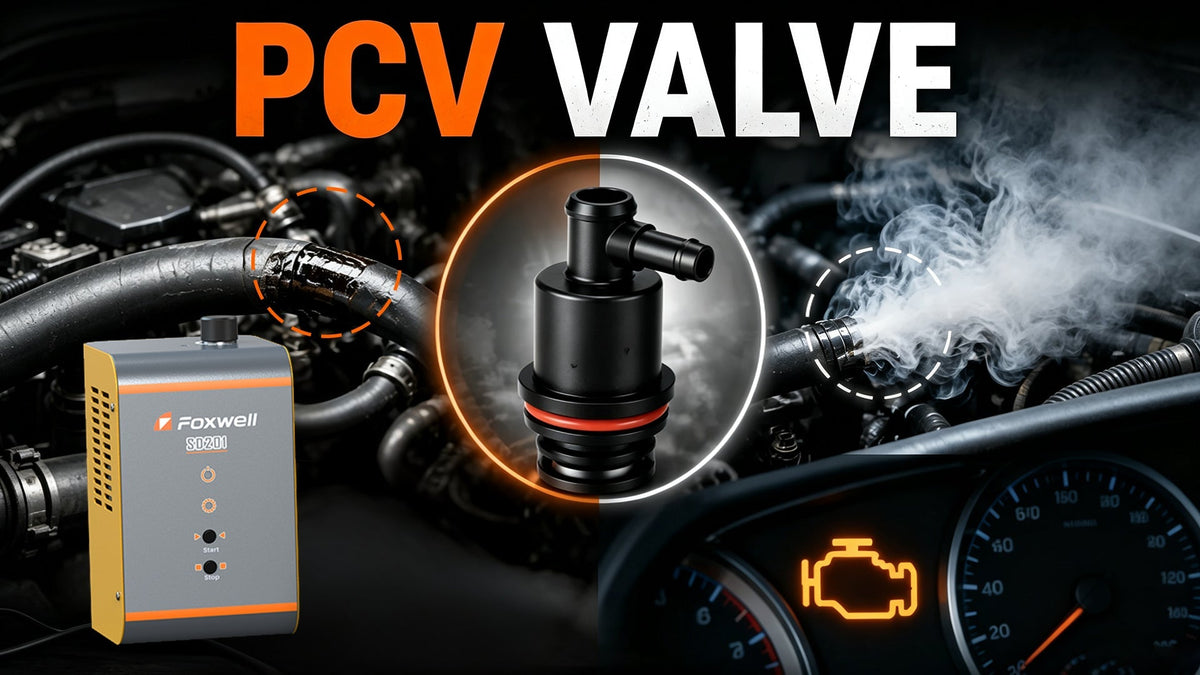
A failing PCV (positive crankcase ventilation) valve behaves differently depending on how it fails. When the valve sticks closed, crankcase pressure builds up and can push oil past gaskets and seals. When it sticks open, unmetered air leaks into the intake and creates a lean-running condition that shows up as rough idle, misfires, or fuel-trim codes.
Because these symptoms overlap with other common engine problems — a cracked intake gasket, a failing MAF sensor, or a vacuum leak elsewhere in the system — confirming the PCV valve as the actual cause takes more than a visual check. This guide walks through physical inspection, vacuum testing, and using OBD2 scanner data (fuel trims, O2 readings, and stored codes) to isolate a PCV problem before you replace the part.
What Is a PCV Valve and Why It Matters
The PCV valve is a one-way valve that routes crankcase blow-by gases — combustion byproducts that leak past the piston rings during normal operation — back into the intake manifold to be burned again instead of vented into the atmosphere. It's a small part, but it sits at the intersection of three systems at once: emissions control, crankcase pressure regulation, and air-fuel metering, since it feeds directly into the intake.
On most engines it's mounted on or near the valve cover and connected to the intake manifold by a short hose. Because it constantly handles oil vapor and blow-by gases, it's also one of the more failure-prone parts under the hood — sludge and carbon deposits gradually clog the valve or its passages, especially on engines that see frequent short trips or infrequent oil changes.

Common Symptoms of a Bad PCV Valve
A PCV valve fails in one of two ways — stuck closed or stuck open — and each produces a different symptom pattern. Recognizing which pattern you're seeing helps narrow down the testing steps below.
If the PCV Valve Is Stuck Closed
When deposits block the valve opening, crankcase gases can no longer vent normally and pressure inside the engine builds up. Drivers typically notice:
- A whistling or hissing sound from the engine bay, caused by pressure escaping through a weak seal or hose joint
- A check engine light, since restricted PCV flow can affect the air-fuel ratio the ECU is trying to maintain
- Noticeably worse fuel economy
- Oil leaks or seepage at the rear main seal, valve cover gasket, or oil pan gasket, as trapped pressure forces oil past worn seals
If the PCV Valve Is Stuck Open
When the valve fails in the open position, it behaves like a permanent vacuum leak, feeding unmetered air into the intake.
Common signs include:
- Rough idle or a misfire, since the extra air leans out the fuel mixture the ECU was not expecting
- Visible oil residue inside the PCV valve or its hose
- Hard or inconsistent starting
- Blue or black smoke from the exhaust and oil-fouled spark plugs, which indicate oil is being pulled into the combustion chamber through the intake system.
|
Valve Condition |
What You'll Notice |
Why It Happens |
|
Stuck Closed |
Whistling or hissing noise |
Pressure escaping through a weak seal |
|
Stuck Closed |
Check engine light |
Air-fuel ratio thrown off by restricted PCV flow |
|
Stuck Closed |
Reduced fuel economy |
ECU compensating for abnormal crankcase pressure |
|
Stuck Closed |
Oil leaks at gaskets/seals |
Trapped crankcase pressure pushing oil past seals |
|
Stuck Open |
Rough idle / misfire |
Unmetered air leans out the air-fuel mixture |
|
Stuck Open |
Oil inside valve or hose |
Oil being drawn through the open valve |
|
Stuck Open |
Hard starting |
Vacuum leak affecting cold-start fuel trim |
|
Stuck Open |
Blue/black exhaust smoke, fouled plugs |
Oil pulled into the combustion chamber |
These symptoms can also point to other issues — a vacuum leak elsewhere in the intake, a failing MAF or O2 sensor, or worn valve seals — so treat this table as a starting point rather than a confirmed diagnosis. The testing methods below are what actually narrow it down.
How to Test a PCV Valve
A visual check tells you whether the valve is grossly clogged or leaking oil, but it won't confirm whether the PCV system is actually causing your symptoms. Combining the three methods below gives a far more reliable answer than any single check on its own.
Method 1: Physical Inspection
●Remove the valve and check for oil sludge or carbon buildup inside it
●Shake the valve — a healthy PCV valve should rattle freely; one that doesn't rattle is likely stuck or clogged
●Inspect the connecting hose for cracks, softening, or a collapsed section
●Look for oil pooling inside the valve body or hose, which points to a valve that has been stuck open
Method 2: Vacuum / Hand-Held Pump Test
●With the engine off, connect a hand vacuum pump to the valve and apply vacuum from both directions — a good valve should pass air in one direction only
●With the engine idling, carefully pull the valve from its grommet and place a finger over the opening; a functioning valve produces a noticeable vacuum pull, and on many engines the idle will dip briefly because the ECU is compensating for that metered air path
●No vacuum felt at idle generally points to a valve stuck closed; an idle that doesn't change at all when the valve is blocked can point to a leak elsewhere in the hose or intake rather than the valve itself.
Method 3: Using an OBD2 Scanner to Diagnose PCV Valve Problems
1.Stored trouble codes can provide the first clue. Codes such as P0171 (System Too Lean), P0174 (System Too Lean Bank 2), or PCV-related manufacturer-specific codes may indicate a possible issue with the PCV system.
2.Live data helps confirm the diagnosis. High positive fuel trims (STFT/LTFT), combined with abnormal O2 sensor or MAP/MAF readings, can point to unmetered air entering through a faulty PCV valve or hose.
3.A full-system scanner such as the Foxwell NT809BT allows technicians to view engine codes, freeze frame data, and live fuel trim readings to help determine whether the problem comes from the PCV system or another vacuum leak. The Foxwell NT710 also supports advanced diagnostics for further troubleshooting.
Can a Smoke Test Detect PCV System Leaks?
Yes. PCV hoses, grommets, and valve seats are small, low-pressure connections that rarely leak visibly, which makes a smoke test one of the fastest ways to catch a leak that a vacuum gauge alone would miss — especially when fuel trims stay lean but nothing looks obviously wrong on inspection.
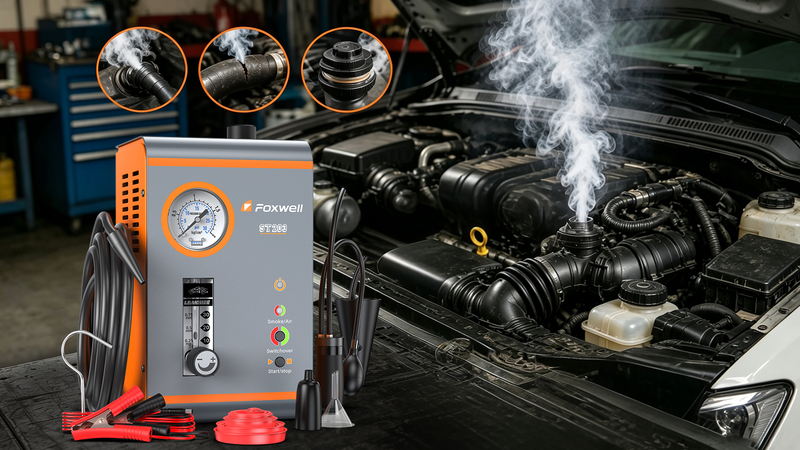
The process is straightforward: a smoke machine connects to the intake system and fills it with a low-pressure, visible smoke. Any point where that smoke escapes — a hairline crack in the PCV hose, a loose grommet, a worn valve seat — becomes visible, so you can pinpoint the exact leak location instead of guessing. Tools built for this, such as the Foxwell SD201, and ST203 smoke machines, include a lower-pressure EVAP/vacuum mode that's gentle enough for PCV and vacuum hoses, as opposed to the higher-pressure mode meant for more robust systems like the exhaust or turbo piping.
A smoke test is most useful when: the code is intermittent, there's no obvious leak visible during physical inspection, or fuel trims stay lean even after the PCV valve itself has been ruled out.
PCV Valve vs Purge Valve: What's the Difference?
The PCV valve and the purge valve are easy to confuse because both connect to the intake system and both can cause similar-looking symptoms — rough idle, a lean code, a check engine light. But they belong to entirely different systems and fail for different reasons.
|
|
||
|
System |
Crankcase ventilation |
Evaporative emissions (EVAP) |
|
What it moves |
Blow-by gases from the crankcase |
Fuel vapor from the charcoal canister |
|
Typical location |
Valve cover / intake manifold |
Near the intake manifold, connected to the EVAP canister |
|
Common failure symptom |
Rough idle, oil leaks, lean codes |
Rough idle, failed EVAP monitor |
|
Related DTCs |
P0171, P0174, P052E, P051F |
P0441, P0446, P0455, P0457 |
PCV Valve Problems by Vehicle: Honda, Chevy, Ford, Audi, Toyota & More
PCV system designs vary significantly between manufacturers. Some vehicles use a simple replaceable PCV valve, while others integrate the PCV system into the valve cover or intake manifold, making diagnosis and repair more complicated.
Before replacing a PCV component, it is important to understand your vehicle's design and common failure points.
| Vehicle / Engine | PCV Design | Common PCV Problems | Common Symptoms |
|---|---|---|---|
| Honda 3.5L V6 (Pilot, Odyssey, Accord V6) | PCV valve located under the intake manifold plenum or integrated near the valve cover assembly | PCV valve blockage or ventilation issues | Oil leaks around valve cover, rough idle, increased oil consumption |
| GM 1.4L Turbo (Chevy Cruze, Sonic, Trax, Buick Encore) | PCV check valve integrated into the intake manifold (not a standalone replaceable valve) | Failed internal check valve requiring intake manifold replacement | P0171 lean code, whistling noise at idle, oil consumption, vacuum leak symptoms |
| Ford F-150 EcoBoost (2.7L / 3.5L) | PCV oil separator system integrated into the valve cover | Restricted PCV flow or oil separator issues | Rough idle, misfires, oil leaks, blue/white exhaust smoke on affected models |
| Audi / VW 2.0T (A4, A5, Q5, Tiguan) | Diaphragm-based oil separator integrated into valve cover | PCV diaphragm failure | High-pitched whistle, P0171, P052E, or P2279 codes, lean condition |
| Toyota (Camry, Corolla, RAV4, Highlander, Tacoma) | Usually uses a standalone PCV valve mounted on the valve cover; some newer designs are harder to access | PCV valve clogging or difficult access for replacement | Vacuum-related issues, oil leaks, higher repair labor costs |
Pro tip: While PCV failures vary by vehicle design, the diagnostic approach remains similar: check for related trouble codes, analyze fuel trim data, inspect PCV components, and use a smoke test to locate possible vacuum leaks.
PCV design and symptoms by vehicle/engine
|
Vehicle / Engine |
PCV Design |
Common Symptom |
Related Codes |
|
Honda 3.5L V6 (Pilot, Odyssey) |
Standalone valve under intake plenum or valve cover |
Oil leak at valve cover, rough idle |
P0171, P0300-series |
|
GM 1.4L Turbo (Cruze, Sonic, Trax, Encore) |
Non-serviceable check valve in intake manifold |
Whistling at idle, oil consumption |
P0171 |
|
Ford 2.7L/3.5L EcoBoost (F-150) |
Oil separator integrated into valve cover |
Rough idle, misfire, oil leaks; smoke on 2013–15 models |
P0171, P0174, P04DB |
|
Audi/VW 2.0T (A4, A5, Q5, Tiguan) |
Diaphragm-based separator in valve cover |
High-pitched whistle, oil consumption |
P0171, P052E, P2279 |
|
Toyota (Camry, Corolla, RAV4, Highlander) |
Standalone valve, standardized part numbers |
Generally low failure rate; access can be difficult on some models |
P0171 (uncommon) |
Diagnose PCV Problems with Foxwell Diagnostic Tools
Foxwell diagnostic scanners help you monitor engine data, check related trouble codes, and identify abnormal operating conditions tied to PCV system problems. They complement the physical valve check rather than replace it — a scanner tells you where to look; the physical test confirms what's actually wrong.
-
Foxwell NT809BT — full-system code reading, live data streaming (fuel trims, O2 sensor test, freeze frame data), and bi-directional/active tests for narrowing down whether a lean condition traces back to the PCV system
- Foxwell NT710 — a bi-directional scan tool, and an upgraded version of the NT530 Plus and NT510 Elite lines, useful for actuation tests on related intake and emissions components
-
Foxwell SD201 / ST203 smoke machines — pair with the scanner once live data points to a vacuum leak, to physically locate the leak point
A practical workflow: pull codes and check freeze-frame data with the scanner first, then inspect and vacuum-test the valve physically, and if fuel trims stay lean with no obvious leak visible, finish with a smoke test to pinpoint the exact hose or gasket that's leaking.
FAQ
What happens if you never replace a bad PCV valve?
A failed PCV valve can cause oil leaks, vacuum leaks, rough idle, and poor fuel economy. A stuck-closed valve increases crankcase pressure, while a stuck-open valve creates an air leak into the intake.
How often should a PCV valve be replaced?
A PCV valve typically lasts 20,000–50,000 miles, but replacement intervals vary by vehicle. Regular oil changes help extend PCV valve life, while short trips and sludge buildup can cause earlier failure.
Can a clogged PCV valve cause a misfire?
Yes. A bad PCV valve can cause misfires by creating a vacuum leak or disrupting crankcase ventilation. Checking fuel trims and O2 sensor data with an OBD2 scanner can help confirm whether the PCV system is the cause.
What does it cost to replace a PCV valve?
The average cost to replace a PCV valve is around $80–$220, including parts and labor. The PCV valve itself usually costs $10–$60, while labor can range from $35–$150 depending on vehicle design and accessibility. If the PCV system is integrated into the valve cover or intake manifold, replacement costs can be higher because the entire assembly may need to be replaced.
Can you clean a PCV valve instead of replacing it?
Yes, some standalone PCV valves can be cleaned, but replacement is usually recommended. Cleaning may remove sludge buildup, but it cannot fix internal wear, damaged springs, or failed diaphragms. Integrated PCV systems built into the valve cover or intake manifold usually cannot be cleaned separately and require component replacement.

Leave a comment
This site is protected by hCaptcha and the hCaptcha Privacy Policy and Terms of Service apply.