

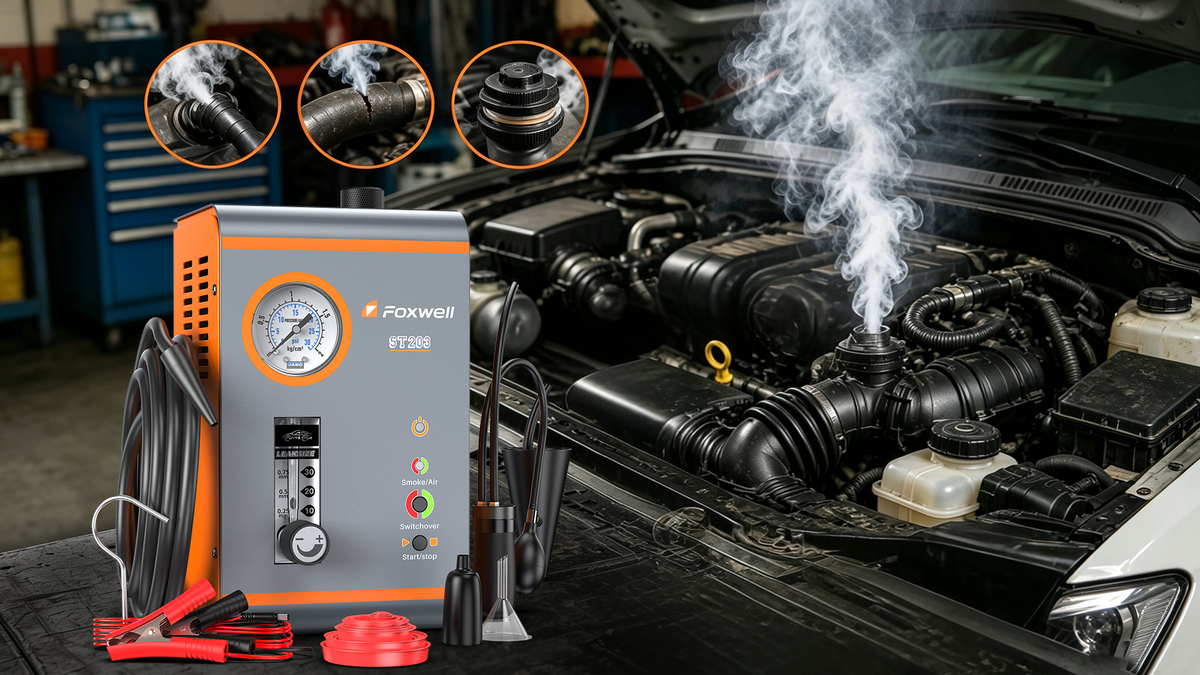
An automotive smoke machine is one of the fastest ways to pinpoint hidden air leaks that codes alone can't show you. This guide walks through what the tool does, when to use it, and exactly how to run a smoke test step by step — plus which machine to buy if you don't already own one.
What is an Automotive Smoke Test Machine?
An automotive smoke machine (also called a smoke test machine or smoke leak detector) is a diagnostic tool that pumps a visible, non-toxic smoke into a vehicle's sealed systems — most commonly the EVAP (evaporative emission control) system, the intake/vacuum system, and turbocharged boost circuits. Because these systems are supposed to hold pressure or vacuum with no air escaping, any point where smoke leaks out is a visual, unmistakable sign of a crack, a loose hose, a bad gasket, or a failed valve.
The machine works by heating a small amount of fluid (typically mineral oil or specialized smoke fluid) until it vaporizes, then pushing that vapor into the sealed system using low air pressure, usually delivered from the vehicle's own 12V battery. Instead of guessing which hose is cracked by ear or by spraying soapy water, a technician can simply watch where the smoke escapes.
Why an Automotive Smoke Machine is Important for You?
Air and vacuum leaks are notoriously difficult to diagnose with a scan tool alone. A code like P0171 (system too lean) or P0455 (EVAP leak detected) tells you that there's a leak — not where it is. Chasing that leak by sound, feel, or carb-cleaner spray can take hours and still miss small or intermittent leaks. A smoke machine removes the guesswork:
●Speed — a leak that might take an hour to find by ear can often be spotted in a couple of minutes once smoke starts filling the pipe
●Accuracy — smoke escapes exactly at the point of the leak, so there's no ambiguity
●Safety — most smoke machines use non-toxic, non-flammable mineral or baby oil-based fluid
●Versatility — the same tool works across EVAP systems, vacuum lines, intake boots, PCV systems, and turbo/boost piping
What Are the Common Issues That Require a Smoke Machine?
●Check Engine Light codes related to EVAP or fuel system leaks
●Rough idle or a lean-running engine caused by an unmetered vacuum leak
●Persistent "check gas cap" warnings even after the cap has been replaced
●Hissing sounds near the intake manifold, throttle body, or vacuum hoses
●Boost leaks on turbocharged or supercharged engines that cause a loss of power
●Failed smog or emissions inspection where a leak in the EVAP system is suspected
●Cracked or disconnected vacuum lines after aftermarket work or engine bay servicing
Common EVAP Trouble Codes That Call for a Smoke Test
If a scan reveals one of the codes below, a smoke test is usually the fastest way to go from "there's a leak somewhere" to "here's exactly where it is." Each code points to a slightly different area of the EVAP system, so knowing which one you're chasing helps you target the smoke test.
P0455 — EVAP System Leak Detected (Large Leak)
P0455 sets when the EVAP monitor detects a large leak — usually big enough that it's easy to find once smoke is introduced. Common causes include a loose, missing, or damaged fuel cap, a disconnected EVAP hose, or a cracked purge/vent line.
How to diagnose it: Follow the EVAP smoke test steps below, paying close attention to the fuel cap seal and any hose that looks disconnected or visibly damaged before you even power on the machine.
Related read: P0455 Code: Evaporative Emission System Large Leak Detected
P0456 — EVAP System Leak Detected (Small Leak)
P0456 is the small-leak version of the same monitor — often triggered by a pinhole crack in a hose, a degraded canister seal, or a fuel cap that seals but not quite well enough. Small leaks like this are exactly what smoke testing is built for, since they're nearly impossible to find by sound or visual inspection alone.
How to diagnose it: A dual-mode machine like the Foxwell ST203 is particularly useful here — use air mode first to confirm the leak exists, then switch to smoke mode to pinpoint it precisely. See the full smoke test procedure below.
P0496 — Evaporative Emission System High Purge Flow
Unlike P0455/P0456, P0496 usually isn't about a leak letting air in — it's about too much air moving through the purge valve when it should be closed, often due to a purge valve stuck open or a routing issue in the purge line. A smoke test can still help here by confirming whether the purge valve is holding pressure correctly when the system is sealed.
Related read: P0496 Code: EVAP Flow During Non-Purge Condition
How to diagnose it: With the engine off, pressurize the EVAP system as described in the EVAP leak testing steps below, then check whether smoke escapes through the purge valve itself — a sign it isn't sealing.
Not sure which code you're dealing with, or want the full breakdown of the EVAP system itself? Start with our EVAP system guide for the bigger picture.
How to Properly Use an Automotive Smoke Machine?
Here is the standard procedure for running a smoke test. Always check your specific machine's manual, but the general workflow looks like this:

Step 1 — Fill the Machine
Add 10-15 ml of baby oil (or the manufacturer-specified smoke fluid) to the smoke machine's reservoir. This is only necessary the first time you use the machine or when the reservoir runs low.
Step 2 — Disconnect the Line You're Testing
Identify the system you want to test (EVAP line, vacuum line, intake boot, etc.) and disconnect the appropriate pipe or fitting so you can connect the smoke machine's hose to it.
Step 3 — Power On
Connect the machine to the vehicle's 12V battery and flip the power switch. The internal heating element will begin vaporizing the fluid and generating smoke.
Step 4 — Inspect for Leaks
After about 30 seconds, smoke will begin filling the pipe and pressurizing the system. Watch closely for smoke escaping anywhere along hoses, gaskets, connectors, or the fuel cap area. Using a shop light or headlamp makes faint leaks much easier to spot, especially in low-light engine bays.
Warning Tips
●Never exceed the recommended pressure for the system you're testing — vacuum and EVAP systems are designed for very low pressure, and over-pressurizing can damage seals or sensors
●Disconnect sensitive components (like a MAF sensor) if recommended by the manufacturer, since smoke residue can occasionally affect airflow sensors
●Work in a ventilated space for clear visibility and good shop practice
●Let the engine cool before testing if you're working near hot exhaust components
●Cap off open ports you're not actively testing so pressure doesn't just escape through an intentional opening and mask the real leak
How To Use A Smoke Machine To Find Vacuum And EVAP Leaks?
For vacuum leaks:
●With the engine off, connect the smoke machine to the intake system, typically through a vacuum port near the throttle body or a brake booster line
●Pressurize gently and watch the entire intake tract — throttle body gaskets, PCV hoses, intake manifold gaskets, and vacuum-operated accessories
●A steady stream of smoke at any seam indicates the leak point
For EVAP leaks:
●Locate the EVAP service port (often near the purge valve or in the engine bay) or introduce smoke through the fuel filler neck with the gas cap removed
●Pressurize the system and check the fuel cap seal, filler neck, charcoal canister, purge valve, and all EVAP hoses running toward the fuel tank
●Because EVAP systems run the full length of the vehicle to the fuel tank, take your time — a leak near the rear of the car can take longer for smoke to reach and reveal itself
What Oil To Use in Automotive Smoke Machine?
Most consumer and professional smoke machines are designed to run on baby oil (mineral oil), added in small quantities of roughly 10-15 ml per fill. Baby oil is popular because it's inexpensive, produces a dense, easy-to-see white smoke, and is non-toxic and safe for engine bay use. Some machines also accept dedicated smoke fluid sold specifically for leak-detection equipment, which is formulated to vaporize cleanly and leave minimal residue. Always check your specific machine's manual, since using an incompatible fluid can clog the heating element or reduce smoke output.
Choosing the Right Automotive Smoke Machine
The market has no shortage of options, from budget consumer kits to shop-grade units. Buyers researching this category commonly compare tools like the VEVOR automotive smoke machine leak detector and the Solary automotive smoke machine leak detector against dedicated automotive diagnostic brands. If you want a tool built specifically around real-world EVAP and vacuum diagnostics, Foxwell's automotive smoke machine lineup is worth a look:
|
Test modes |
Dual mode: air + smoke |
Smoke mode |
|
Smoke generation |
~10 seconds |
Variable-frequency, 10-min work cycle |
|
Built-in gauge |
Pressure gauge + flowmeter |
— |
|
Protection |
Standard thermal protection |
Overheat (248°F) + anti-frost (-68°F) |
|
Output pressure |
Adjustable smoke output |
0.8-1.2 bar |
|
Weight |
5.5 lb |
Compact / portable |
|
Systems covered |
EVAP, intake, turbo, fuel tank, exhaust, EGR |
EVAP, intake, turbo, fuel tank, exhaust, EGR |
|
Best for |
Faster, more precise dual-mode diagnosis |
Budget-friendly everyday leak checks |
Conclusion
An automotive smoke machine takes the guesswork out of chasing vacuum and EVAP leaks. By filling the reservoir with a small amount of baby oil, connecting to the system you're testing, powering the unit from the vehicle's 12V battery, and watching closely for escaping smoke, you can pinpoint leaks in minutes instead of hours. Whether you go with a budget kit or a purpose-built tool like the Foxwell ST203 or SD201, the fundamental process stays the same — and it remains one of the most reliable ways to solve check-engine-light mysteries related to air and vacuum leaks, including EVAP codes like P0455, P0456, and P0496.
FAQ
Can I use a smoke machine to find a vacuum leak?
Yes. Connecting the smoke machine to the intake system and watching for smoke escaping at hoses, gaskets, or connections is one of the most common and effective ways to locate vacuum leaks.
Can you use a smoke machine to find exhaust leaks?
Smoke machines are primarily designed for low-pressure systems like vacuum and EVAP lines. Exhaust systems operate at much higher temperatures and pressures, so smoke testing is far less common there and generally not recommended with standard automotive smoke machines.
How long does a car smoke test take?
A typical smoke test takes approximately 1-2 hours, depending on the complexity of the system being tested and how quickly the leak is located.
Can a smoke test damage your engine?
When performed correctly, at the recommended low pressure, a smoke test will not damage your engine. Risks mainly arise from over-pressurizing a system beyond its design tolerance, so always follow the machine's recommended settings.
Can a smoke test detect oil leaks?
Smoke testing is designed for air/vacuum leaks in sealed systems, not for liquid oil leaks. Oil leaks are typically diagnosed visually or with UV dye rather than smoke.
Can I use a smoke machine on any vehicle?
Most automotive smoke machines are compatible with any vehicle that has a standard 12V battery and conventional vacuum/EVAP systems, which covers the vast majority of gasoline-powered cars, trucks, and SUVs. Always check your machine's specifications for compatibility with hybrid or specialty systems.

Leave a comment
This site is protected by hCaptcha and the hCaptcha Privacy Policy and Terms of Service apply.