

Quick answer
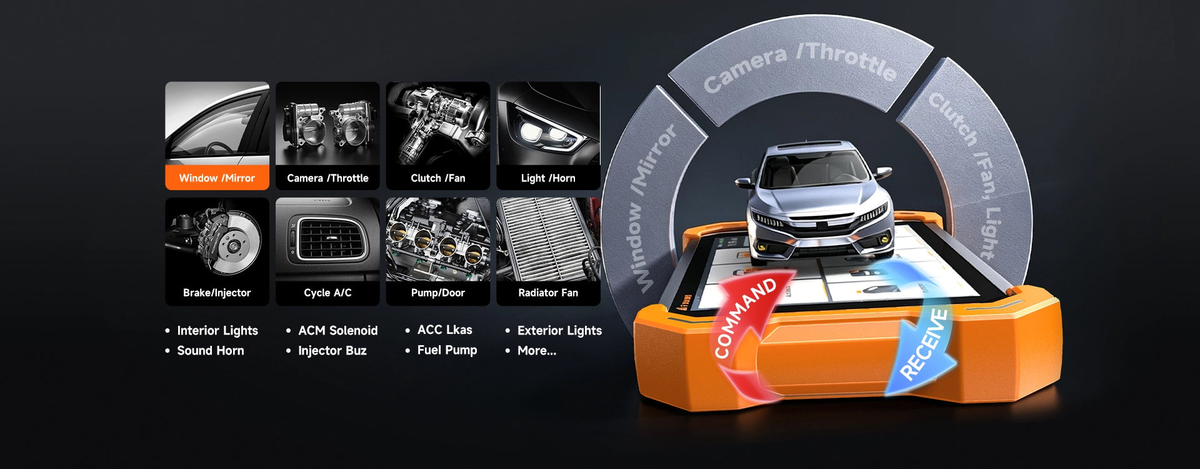
A bidirectional scan tool sends commands to a vehicle's control modules and lets you watch components respond. It can cycle an ABS pump, disable an injector, activate a cooling fan, or open an EVAP valve on demand. This helps confirm a fault before parts are removed or replaced. Available tests always depend on the exact vehicle.
What Is Bidirectional Control & Why Does Your Garage Need It?
A basic code reader only tells you what a module already reported. Bi-directional control flips that around — it lets you tell a module what to do, then watch whether the part actually obeys.
Old way
Pull the fan, injector, or pump and bench-test it by hand — or replace it and hope
Bi-directional way
Send the command from the scanner's screen and watch the part respond in real time
Why it matters
Turning a guess into a confirmed diagnosis before you order a single part
That is the value of bidirectional control: it turns the scanner from a code reader into a diagnostic command center. Below are ten active tests that can make the biggest difference in the garage. Exact coverage still depends on the vehicle's make, model, year, system, and software version.
10 High-Value Active Tests You Can Perform (Real-World Examples)
No scanner runs every test below on every car. Function availability varies by vehicle model, year, system, and software coverage. These ten tests are among the most useful examples in real diagnostic work and are included within the Foxwell NT919 BT library of 3,000+ active tests. The tool also includes 34+ maintenance services.
1. ABS Pump & Solenoid Actuation Test
The problem: ABS warning lights, hydraulic faults, or suspected pump or solenoid problems
The active test: command the ABS pump motor or supported hydraulic solenoids on demand
What the result tells you: if the pump or solenoid responds when commanded, you can confirm that the component and at least part of its control circuit are responding. Further electrical or hydraulic testing may still be required.
Realted Reading: Why Do You Need a Scan Tool to Bleed ABS Brakes?
2. Fuel Pump Actuation & Pressure Test
A P0089 fuel rail pressure code could mean a dying pump, a bad relay, or a stuck regulator — and pulling the tank on a guess is a two-hour job.
•The problem: P0089 or low/erratic fuel rail pressure with an unclear cause
•The active test: command the fuel pump relay on/off while watching the fuel rail pressure PID on live data
•What the result tells you: if pressure builds and holds when the pump is commanded on, the pump circuit is responding and you can focus on the regulator, sensor data, or another part of the system. Viewing the command and live pressure data together makes the result easier to interpret.
Related Reading: How Do You Test a Fuel Pump to See if It's Good?
3. EVAP Purge & Vent Solenoid Test
P0440/P0446 codes are notorious for only setting during a specific drive cycle you can't reproduce on demand.
•The problem: evaporative-system code that won't reproduce without a long, specific drive cycle
•The active test: command the purge or vent solenoid open and closed right now instead of waiting for the drive cycle
•What the result tells you: if the purge or vent solenoid responds when commanded, the control circuit and actuator are at least responding to the scan tool. If it does not respond, further checks of the valve, wiring, power, ground, and related controls may be needed.
Related Reading: Purge Valve: Symptoms, Testing, Live Data Analysis and Common Trouble Codes
4. Door Lock Actuator Cycle Test
The problem: one door will not lock or unlock normally
The active test: command an individual door lock actuator to lock and unlock from the scanner
What the result tells you: if the actuator responds to scanner commands but not the door switch or remote, the fault may be elsewhere in the control circuit. If it does not respond, inspect the actuator, wiring, power, and ground.
5. Radiator Cooling Fan Speed Control
An engine that runs hot in traffic but cools fine on the highway usually points at the fan, its relay, or the wiring.
•The problem: overheating in traffic, fine at highway speed — fan, relay, or wiring unclear
•The active test: command the fan on directly and confirm it spins at the commanded speed
•What the result tells you: if the fan runs when commanded, the motor and at least part of its control circuit are working. If it does not, you can move to relay, power, ground, wiring, or fan-motor checks.
6. Fuel Injector Cut-Off Test
A misfire under load could be one bad injector — or four marginal ones — and pulling plugs one at a time to find out is slow.
•The problem: rough idle or misfire under load, cylinder source unclear
•The active test: command the cooling fan on, or select a supported fan stage, and confirm the fan responds
•What the result tells you: the cylinder that causes little or no RPM change when disabled is the one to investigate. Compare the result with misfire counts, fuel trims, ignition, compression, and injector checks before replacing parts.
7. A/C Compressor Clutch Engagement Test
When the clutch won't engage, the question is always electrical fault vs. low refrigerant charge protecting the compressor.
•The problem: A/C compressor clutch not engaging — electrical or low-charge protection
•The active test: command the clutch relay on and watch or listen for the compressor to engage
•What the result tells you: if the clutch engages when commanded, the clutch and at least part of its control circuit are responding. If it does not, check system pressure, safety inputs, relay control, wiring, and the compressor circuit before drawing a final conclusion.
8. Power Window Motor Test
•The problem: a power window does not move or only works intermittently
•The active test: command the supported window motor up or down through the vehicle control module
•What the result tells you: if the window moves when commanded by the scanner, the motor and module output are responding, which can help narrow the fault to the switch, wiring, or related inputs.
9. EGR Valve Operation & Position Test
Rough idle, hesitation, or a stored EGR code could be a clogged valve, a stuck pintle, or a wiring fault — three very different repair bills.
•The problem: rough idle, hesitation, or stored EGR code with an unclear cause
•The active test: command the EGR valve to a specific open percentage and watch the actual position PID follow it
What the result tells you: compare commanded position with actual position. If they do not track, check the valve, power, ground, wiring, and position feedback before assuming carbon buildup is the only cause.
10. Lighting & Horn Output Test
The problem: a headlight, turn signal, reverse light, or horn does not operate normally
The active test: command supported lights, horn outputs, or related relays directly from the scanner
What the result tells you: if the output works when commanded, the component and part of the output circuit are responding. If it does not, check the fuse, relay, wiring, connector, ground, or component itself.
How to Choose the Right Bidirectional Scanner: Watch Out for Hidden Fees
The sticker price on a bidirectional scanner is rarely the real cost of owning it. Most platforms bill an annual subscription just to keep receiving new vehicle coverage.
•Autel: annual renewal (“Total Care Program”) runs about $99 for entry-level readers up to $699 for flagship tablets; mid-range tools like the MS906PRO-TS run close to $499/year
•Launch X431: renewals commonly cited between roughly $150 and $600/year depending on the tablet tier
•Foxwell NT919 BT: lifetime free software updates with no annual renewal fee for the included coverage
|
Tool |
Typical Annual Update Fee |
Notes |
|
Foxwell NT919 BT |
$0 — lifetime free updates |
Lifetime software updates included; CAN FD and DoIP supported |
|
Autel (mid-range, e.g. MS906PRO-TS) |
~$499/year after year 1 |
Tool keeps working without renewal, but stops receiving new vehicle coverage |
|
Autel (entry to flagship range) |
$99–$699/year |
Wide range by tier; flagship tablets sit at the top end |
|
Launch X431 (mid-range) |
~$150–$600/year |
Varies by tablet; premium PAD models often route through a cloud subscription |
Over a typical 4–5 year ownership window, that recurring fee alone can exceed the original tool cost — worth running against your own vehicle mix before comparing sticker prices side by side.
Why Foxwell NT919BT Is the Ultimate Choice for Active Testing•Lifetime Free Updates — $0 annual subscription, unlike most competing platforms •Native CAN FD & DoIP support for 2019-and-newer vehicles •All-System Bi-Directional Control across Engine, ABS, SRS, BCM, TPMS, HVAC & Steering •Wireless Bluetooth 5.0 — work from the wheel or the fender, not tied to the dash  → View the Foxwell NT919BT (20% off list) |
Frequently Asked Questions
Q: Does a bidirectional scan tool need an annual subscription?
It depends on the brand. Some professional scanners include a limited update period and then charge for continued updates. The Foxwell NT919 BT includes lifetime free software updates for its included coverage, although third-party services such as FCA AutoAuth may still have separate fees.
Q:Is a bidirectional scan tool worth it?
Yes, if you regularly diagnose vehicles. Active tests help confirm whether components work before you replace parts.
Q:Can a bidirectional scanner program keys?
Some can perform key matching on supported vehicles, but bidirectional control alone does not guarantee key programming. Always check vehicle compatibility first.
Q:Do I need a scan tool to bleed ABS brakes?
Not for every brake bleed. However, if air enters the ABS module, a compatible scan tool may be required to cycle the ABS pump and complete the bleeding procedure.

Leave a comment
This site is protected by hCaptcha and the hCaptcha Privacy Policy and Terms of Service apply.