

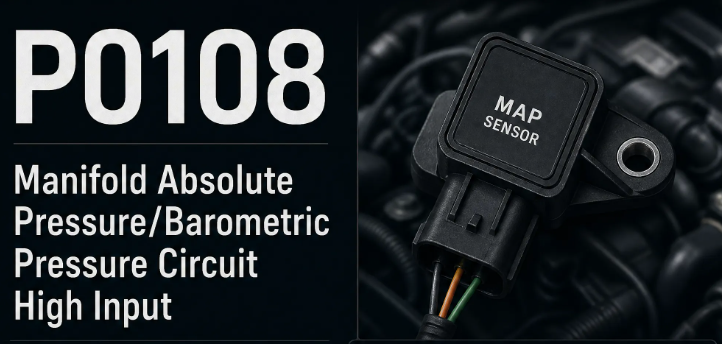
If your check engine light just came on and a scan tool pulled up P0108, you're dealing with a Manifold Absolute Pressure (MAP) sensor circuit problem. This code shows up on Dodge, Honda, Ford, Toyota, Jeep, VW, Hyundai, and Suzuki models alike, and while the fix is usually simple, driving around with it can hurt your fuel economy and your engine.
This guide breaks down what P0108 means, why it happens, how to diagnose it at home, and how to fix it — with model-specific notes and real repair costs.
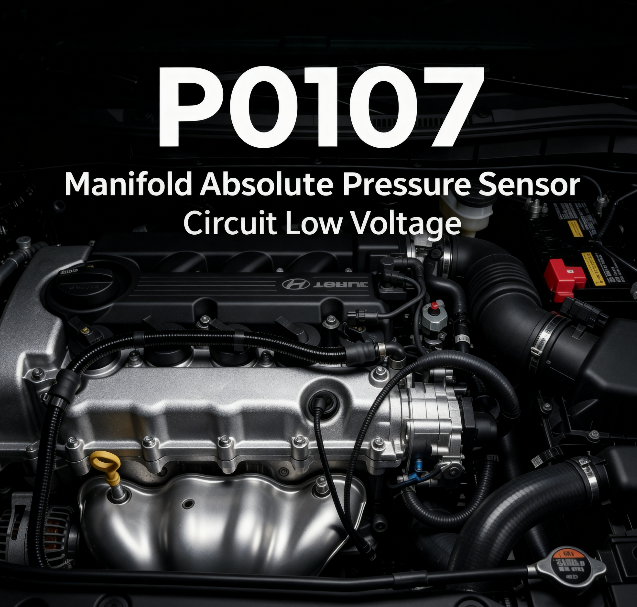
⚠️Not sure which code you have? P0108 is a high-voltage circuit fault. Its close cousin, P0107 (MAP Sensor Circuit Low Input), is the opposite problem — a low-voltage signal. Double-check your scanner readout before diagnosing, since the causes overlap but the voltage tests point in opposite directions. This article covers P0108 only.
What Does the P0108 Error Code Mean?
P0108 stands for "Manifold Absolute Pressure/Barometric Pressure Circuit High Input." It's a generic powertrain code, meaning it applies to any OBD-II vehicle built since 1996, even though the exact wiring and repair steps differ by make.
The MAP sensor sits on or near the intake manifold and measures the vacuum (negative pressure) created as the engine draws in air. It converts that pressure into a voltage signal — typically around 1 volt at idle, rising to about 5 volts at wide-open throttle. The Engine Control Module (ECM) uses this reading, along with input from the throttle position sensor and RPM, to calculate engine load and set the fuel injector pulse width.
P0108 sets when the ECM sees a MAP/BARO signal voltage above roughly 4.5 volts for about 10 seconds or more, while other sensor readings (throttle position, RPM, oxygen sensors) suggest the engine isn't actually under that much load. In plain terms: the ECM thinks the intake pressure is way too high for what the engine is actually doing, so it flags the circuit.
Common Symptoms of the P0108 Error Code
You'll usually notice performance problems before you even scan the code. Here's what tends to show up:
| Symptom | Why It Happens |
|---|---|
| 💡 Check Engine Light on | ECM detects MAP voltage out of range |
| 🌀 Rough or unstable idle | Wrong MAP reading throws off idle fuel/air mix |
| 🐌 Hesitation or sluggish acceleration | ECM miscalculates engine load under throttle |
| ⛽ Poor fuel economy | ECM often over-fuels, running the engine rich |
| ⚫ Black smoke from the exhaust | Rich air-fuel mixture from bad MAP data |
| 🔑 Hard starting or stalling | Incorrect starting fuel trim from MAP/BARO reading |
| 🛑 Engine may run in "limp" or reduced-power mode | ECM defaults to a safe fuel map when it can't trust the sensor |
Not every vehicle shows every symptom — some cars run almost normally with P0108 stored, while others idle so poorly they're hard to drive.
What Causes a P0108 Code?
Most P0108 codes trace back to one of five root causes:
🧩 Faulty MAP sensor — Internal sensor failure from age, heat, oil contamination, or a cracked diaphragm can send a constant high-voltage signal.
🔌 Wiring or connector problems — The MAP sensor uses three wires: a 5V reference, a ground, and a signal wire. A short to power, corrosion, a chafed wire, or a loose connector can push the signal above the normal range.
💨 Vacuum leaks — A cracked vacuum hose, split intake boot, or leaking intake gasket changes the actual manifold pressure, which the ECM can misread as abnormally high.
🧯 Clogged or failing catalytic converter — Backpressure changes can occasionally affect intake pressure readings on some platforms.
🖥️ ECM/PCM fault — Less common, but a failing voltage regulator inside the control module can misinterpret an otherwise normal sensor signal.
Because P0108 is a "circuit high" code rather than a generic "range/performance" code, wiring and connector issues are worth checking first — they're cheaper to rule out than replacing the sensor.
P0108 Across Different Makes and Models
P0108 is a generic code, but the sensor location, connector type, and common failure points vary by manufacturer. Here's a quick reference based on common searches and real-world repair cases:
| Make/Model | Typical MAP Sensor Location | Common Root Cause | Notes |
|---|---|---|---|
| 🇺🇸 Dodge / Chrysler | On or near intake manifold | Corroded connector, failed sensor | Common on higher-mileage V6/V8 engines |
| 🇯🇵 Honda (Civic, Accord) | Mounted on intake manifold | Oil-contaminated sensor vent | Clean the vent before replacing the sensor |
| 🇺🇸 Ford (Mustang, F-150) | Intake manifold or throttle body area | Vacuum leak, sensor failure | Older frequency-type MAP sensors need special testing |
| 🇯🇵 Toyota (Corolla, Hilux, 2KD engines) | Intake manifold, sometimes combined with IAT sensor | Wiring short, vacuum hose crack | 2KD diesel engines pair MAP with boost pressure logic |
| 🇺🇸 Jeep (Cherokee, Grand Cherokee) | Top of intake manifold | Aging sensor, vacuum leak | Frequently paired with P0107 or P0106 |
| 🇩🇪 VW / Audi | Integrated with throttle body on some models | Connector corrosion | Check TSBs — some VW models had recall-level sensor issues |
| 🇰🇷 Hyundai (i10 and similar) | Intake manifold | Sensor failure, wiring | Usually a straightforward sensor swap |
| 🇯🇵 Suzuki | Intake manifold | Vacuum leak, sensor age | Common on smaller displacement engines |
If you're not sure exactly where your MAP sensor lives, a repair manual or a scan tool with vehicle-specific component locations (many enhanced OBD2 scanners include this) will save you time hunting under the hood.
How to Diagnose P0108
Diagnosing P0108 correctly means confirming which part of the circuit is actually failing before you buy parts. Here's the process a technician would follow:
1️⃣ Scan for all stored codes, not just P0108. Codes like P0106, P0107, or P0109 alongside P0108 often point to a shared wiring or connector issue rather than the sensor itself. A capable OBD2 scanner — something like the Foxwell NT301 — reads generic and enhanced codes together, so you're not missing related faults.
2️⃣ Check freeze frame data. Freeze frame shows the exact RPM, throttle position, and coolant temp when the code set. This tells you whether the fault happened at idle, cruising, or acceleration — a big clue toward vacuum leaks versus wiring shorts.
3️⃣ Inspect the wiring harness and connector. Look for chafed insulation, corrosion, bent pins, or a connector that isn't fully seated. Wiggle the harness with the key on to see if the live data reading jumps.
4️⃣ Test MAP sensor voltage with a multimeter. Backprobe the signal wire with the key on, engine off, then running. You should see roughly 4.5–5V key-on/engine-off, dropping to about 1V at idle. A reading stuck near or above 4.5V during idle confirms a genuine high-signal fault.
5️⃣ Watch live data on a scan tool while driving. This is where a scanner with graphing live data really helps — you can watch the MAP sensor PID rise and fall in real time and compare it against throttle position and RPM. Tools like the Foxwell NT530 or NT301 display this data as a graph, making it much easier to catch an erratic or flat-lined signal than reading raw numbers.
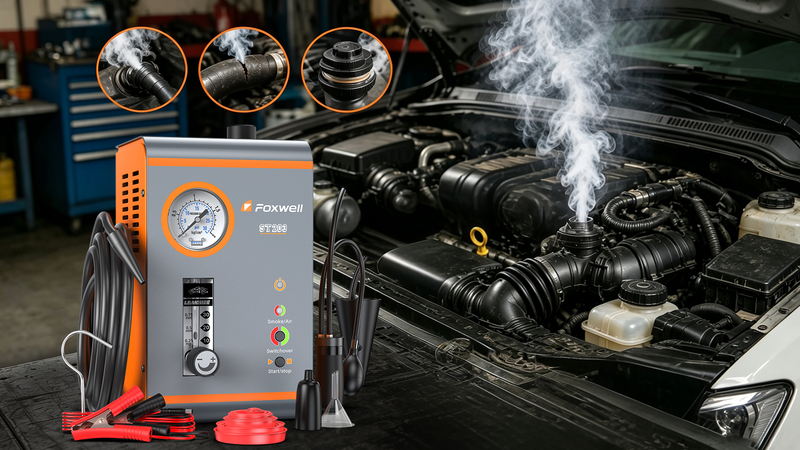
6️⃣ Check for vacuum leaks. Use a smoke test, or spray a small amount of brake cleaner around vacuum connections while the engine idles (watch for RPM changes) to find leaks.
How to Fix P0108
Once you've confirmed the cause, the fix depends on what's actually broken:
- 🔌 Wiring or connector damage: Repair or replace the damaged section of harness, clean corrosion, and make sure the connector locks fully into place.
- 🧩 Faulty MAP sensor: Replace the sensor — this is the most common fix and typically takes 15–30 minutes with basic hand tools.
- 💨 Vacuum leak: Replace the cracked hose, split intake boot, or leaking gasket. Re-torque intake manifold bolts if the gasket seal looks compromised.
- 🧽 Contaminated sensor: On Honda and similar engines where oil can foul the MAP sensor vent, cleaning it with electronics-safe cleaner sometimes resolves the code without a full replacement.
- 🖥️ ECM issue: Rare, and usually requires dealer-level diagnosis or a VIN-programmed replacement module — not a DIY-friendly repair.
✅ After any repair:
- Clear the code with an OBD2 scanner.
- Do a test drive covering idle, acceleration, and highway speed.
- Recheck for the code and monitor live MAP data to confirm the reading now tracks normally with throttle and RPM.
A code reader that both clears codes and streams live data in one device — the Foxwell NT301 and NT301 Plus are common choices for DIYers — saves you a second trip to the shop just to confirm the repair actually worked.
Other Codes Related to P0108
P0108 belongs to a family of MAP/BARO sensor codes. If your scanner pulls more than one of these at the same time, it's a strong sign the problem is shared wiring, a bad ground, or a connector issue rather than the sensor alone:
| Code | Definition | How It Differs from P0108 |
|---|---|---|
| P0105 | MAP/BARO circuit malfunction | A general circuit fault, often an open circuit or intermittent signal loss rather than a fixed high reading |
| P0106 | MAP/BARO circuit range/performance | Signal is present but doesn't track logically with throttle and RPM — often a vacuum leak or aging sensor |
| 🔻 P0107 | MAP/BARO circuit low input | The opposite of P0108 — voltage drops too low (typically under ~0.5V), often from a short to ground or a disconnected sensor. See the dedicated P0107 guide if that's the code you actually have |
| P0109 | MAP/BARO circuit intermittent | Signal cuts in and out, usually pointing to a loose connector or chafed wire |
| P0068 | MAP/MAF-throttle position correlation | Sets when MAP and throttle position readings don't match up, which can accompany P0108 on some platforms |
| P1106 / P1107 | Manufacturer-specific intermittent high/low MAP voltage | Similar to P0108/P0107 but flagged as intermittent faults on certain makes |
⚠️ Quick way to tell P0108 and P0107 apart: the code definition on your scanner will say either "High Input" (P0108, this article) or "Low Input" (P0107). If your live data shows the MAP voltage pinned near 5V, you're in the right place. If it's pinned near 0V, head to the P0107-specific guide instead — the repair steps for a shorted-low circuit are different from a shorted-high one.
If P0108 shows up alongside P0106 or P0107, start with the wiring harness and connector before replacing parts — a single bad ground or corroded pin can trigger more than one of these codes at once. Seeing P0108 with unrelated codes, like a throttle position or coolant temperature code, is more likely a coincidence than a shared cause, but it's still worth noting on the freeze frame data.
Conclusion
P0108 means the ECM is seeing a MAP/BARO sensor signal that's too high for what the engine is actually doing. Most of the time it comes down to a failing sensor, damaged wiring, or a vacuum leak — all repairs well within reach of a confident DIYer with a multimeter and a good OBD2 scanner. Ignoring it can lead to poor fuel economy, rough running, and in worse cases, catalytic converter damage from a chronically rich mixture, so it's worth diagnosing and fixing promptly rather than just clearing the light.
FAQ
1.Can I drive with a P0108 code?
It's not recommended for long. A high MAP signal usually causes the ECM to run rich, which can foul spark plugs and damage the catalytic converter over time. Short trips to a parts store or repair shop are generally fine, but avoid extended driving.
2. Does P0108 affect engine performance?
Yes. Drivers commonly report rough idle, hesitation during acceleration, and reduced fuel economy because the ECM is working from an incorrect load calculation.
3. How much does it cost to fix P0108?
A replacement MAP sensor typically costs $20–$80 for parts, plus $50–$150 in labor if you're not doing it yourself — so most repairs land under $250 total. Wiring repairs are usually even cheaper. ECM replacement, which is rare, can run $300–$800+ with programming.
4. What tools are needed to diagnose P0108?
An OBD2 scanner that reads live data (like the Foxwell NT301 or NT530), a digital multimeter for voltage testing, and basic hand tools for accessing and replacing the sensor. A smoke machine helps if you suspect a vacuum leak.
5. Can low voltage cause a P0108 code?
Not directly — P0108 is specifically a high-voltage circuit code. However, an unstable or low battery/charging system voltage can sometimes cause erratic sensor readings that trigger related MAP codes, so it's worth checking battery voltage during diagnosis. (A true low-voltage MAP fault is logged as P0107, not P0108.)
6. Can a vacuum leak cause a P0108 code?
Yes. A vacuum leak changes the actual pressure inside the intake manifold, which the ECM can interpret as an abnormally high reading, especially at idle. Checking hoses and gaskets is a standard step in diagnosing this code.

Leave a comment
This site is protected by hCaptcha and the hCaptcha Privacy Policy and Terms of Service apply.