

Thermal cameras are powerful diagnostic tools—but they can be misleading if you don’t understand how they work.
In automotive diagnostics, thermal cameras do not show internal heat. They only display surface temperature, which is affected by emissivity and heat transfer.
How Thermal Cameras Detect Heat?
A thermal imaging camera for automotive diagnostics doesn’t actually “see” heat the way your eyes see light. Instead, it detects infrared radiation—a type of energy emitted by all objects above absolute zero.
Here’s what’s really happening behind the scenes:
- Every component in your car (engine, brakes, wiring) emits infrared energy
- The camera captures that radiation using specialized sensors
- It converts the data into a temperature-based image (thermogram)
- Colors represent temperature differences (e.g., red = hot, blue = cool)
This is why thermal imaging is so powerful: it reveals invisible temperature patterns that indicate problems long before they become visible failures.
Thermal cameras detect radiation—not the actual internal temperature of components.
What Is Emissivity and Why It Affects Temperature Accuracy
Definition
Emissivity is a measure of a material’s ability to emit infrared energy compared to a perfect emitter (a blackbody), with values ranging from 0 to 1.
- Symbol: ε
- Unit: dimensionless (no unit)
Why Emissivity Affects Thermal Readings
- Low-emissivity surfaces such as polished metal, chrome and reflective parts reflect external heat instead of releasing their own. This causes falsely low temperature readings and hides actual component heat.
- High-emissivity materials like plastic, rubber, paint and rough metal naturally radiate stable infrared heat, delivering precise and reliable thermal data.
- Without correct emissivity adjustment, thermal devices misjudge hotspots, cold zones and component temperature differences, leading to wrong diagnostic conclusions.
- For automotive testing, shiny engine parts, fasteners and bare wiring are common low-emissivity objects that require manual parameter calibration for valid scans.
Common Material Examples
- Aluminum (polished) → very low emissivity → often appears cooler than it actually is
- Steel (oxidized) → higher emissivity → more accurate readings
- Copper → reflective → can distort measurements
Real-World Problem

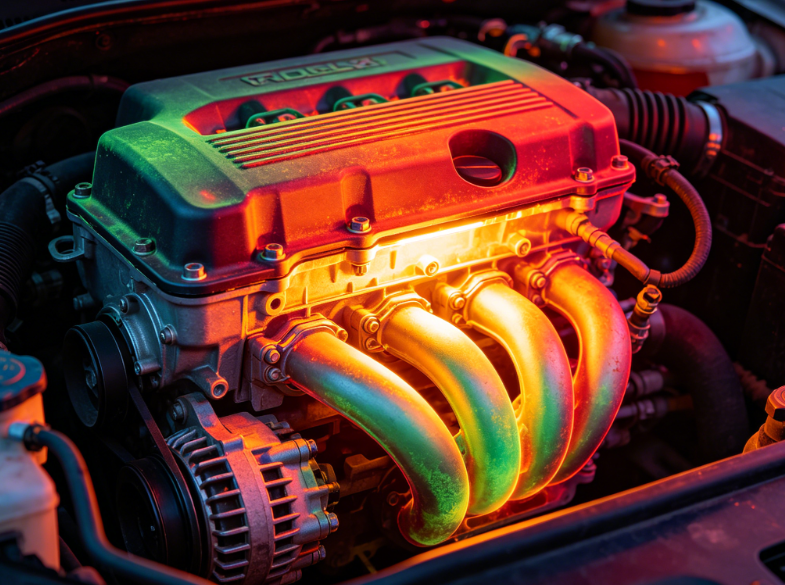
Shiny metal doesn't necessarily mean it's cold. The image above illustrates the "visual deception" that occurs when a thermal imager is applied to different materials.
If you scan an engine bay without adjusting emissivity:
- Shiny metal parts may look “cold”
- Overheating components may go unnoticed
This is one of the main reasons your thermal camera readings may be inaccurate.
That’s why surface readings can appear misleading.
If you want to see real diagnostic cases, check our guide on how to use thermal cameras.
How Thermal Sensors Work Inside a Thermal Camera
At the core of every thermal camera are thermal sensors that convert invisible radiation into usable data.
Step-by-step process:
- Infrared radiation hits the sensor array
- Each pixel detects energy intensity
- The sensor converts heat into an electrical signal
- The processor translates signals into a thermal image
Thermal Sensors vs. Thermo Sensors: What’s the Difference?
| Feature | Thermal Sensors (Imaging) | Thermo Sensors (Contact/Point) |
| Detection Method | Non-contact; detects IR radiation from a distance. | Usually requires physical contact or a single-point laser. |
| Output Type | A 2D "Heat Map" (thousands of data points). | A single numerical temperature reading. |
| Primary Component | Microbolometer array. | Thermistor, Thermocouple, or RTD (Resistance Temp Detector). |
| Automotive Use | Visualizing heat flow across a radiator or engine block. | Monitoring specific coolant or oil temperatures (e.g., the car’s internal temp sensor). |
| Speed | Instant visualization of the entire area. | Requires time for the sensor to reach the object's temperature. |
| Function | Detects IR remotely | Contact measurement |
Automotive diagnostics relies on non-contact thermal sensors for speed and safety. Sensors interpret radiation, not direct temperature.
Why This Matters for Automotive Diagnostics
- Thermal Sensors (used in the Foxwell RT280) allow you to see the Thermal Management of the entire system. For example, you can see if heat is moving through the entire radiator core.
- Thermo Sensors (like the ones built into the engine) only tell the ECU the temperature at one specific spot.
What Is a Bolometer and Why It Matters in Thermal Imaging
A bolometer is the most common type of sensor used in thermal cameras. The bolometer is what makes thermal imaging possible.
- It detects changes in infrared energy
- Converts those changes into measurable electrical resistance
- Enables the camera to map temperature differences across a surface
Why It Matters in Thermal Imaging
| Key Aspect of Bolometer | Details | Why It Matters in Automotive Thermal Imaging |
|---|---|---|
| Core Function | Detects infrared energy → Converts to electrical resistance → Maps surface temperature differences | Enables non-contact thermal imaging (the foundation of thermal camera functionality) |
| Sensitivity (NETD) | Detects temperature differences as small as 0.05°C | Identifies faint heat anomalies: parasitic electrical draws, tiny vacuum leaks, subtle component overheating |
| Response Speed | Near-instant reaction to thermal changes | Captures real-time events: thermostat opening, cylinder misfires, brake heat buildup during driving |
| Durability | Solid-state, uncooled design | Withstands workshop vibrations, extreme temperature swings, and regular use without losing calibration (ideal for automotive repair environments) |
Why Thermal Images Can Be Misleading (Heat Transfer & Thermal Resistance)
Thermal cameras show surface temperature, not internal heat sources.
When you use a thermal camera to diagnose a car, you aren't actually seeing the engine's internal heat; you are seeing how that heat moves through metal, plastic, and rubber to reach the surface.
To interpret what you see, you must understand one rule: Thermal cameras only show surface temperature, not the internal heat source itself.
Heat Transfer: Why the Image Is Delayed
- Heat doesn’t instantly appear on the surface: Heat moves from the inside of a component (like a cylinder wall) to the outside through conduction. This process is not instantaneous.
- Heat transfer takes time (conduction delay): When you start a cold engine, the exhaust manifold doesn't turn red on your thermal screen immediately. The heat must first travel through the thick cast iron.
- Thermal resistance slows heat flow: Materials with high thermal resistance (e.g., thick metal casings, ceramic coatings, or layered components) restrict heat conduction. Even if a part’s interior is overheating, the surface temperature rises slowly—creating a lag between actual internal fault and visible thermal anomaly.
- Some materials act as insulators, hiding internal issues: Components wrapped in insulation, heat shields, or made of low-conductivity materials (e.g., plastic covers, rubber hoses, or fiber-reinforced parts) trap heat inside. This means thermal cameras may not detect internal overheating until the damage is severe, as the insulating layer blocks heat from reaching the surface.
Possible situation:
- A component may be overheating internally
- But the surface still appears normal
This is where many beginners misinterpret thermal images.
Thermal Conductivity vs. Thermal Resistance
These are opposites. Understanding the difference prevents "false positive" diagnoses.
- Thermal conductivity → how fast heat moves through a material
- Thermal resistance → how much a material resists heat flow
👉 High resistance = delayed or hidden heat signatures
Surface Temperature ≠ Internal Temperature
Because of thermal resistance and external factors (like wind from a cooling fan), the temperature on your screen is almost always lower than the internal temperature.
- The "Scale" Effect: A radiator core might look "warm" (e.g., 50°C) on the surface, but the coolant inside is 90°C.
- Emissivity Issues: Shiny surfaces (like a polished chrome intake) have a high "reflective" resistance, making them appear colder than they actually are because they reflect the ambient air temperature instead of emitting their own heat.
How Thermal Cameras Are Used in Automotive Diagnostics
Once you understand how thermal cameras work, you can use them more effectively in automotive diagnostics.
1. Engine Overheating
- Identify blocked radiators
- Detect uneven coolant flow
- Spot failing water pumps
2. Brake System Hotspots
- Find dragging brake pads
- Detect seized calipers
- Compare left vs right temperature differences
3. Electrical Faults
- Locate overheating wires or connectors
- Identify high-resistance circuits
- Detect failing relays or fuses
Where Foxwell Fits
In real-world automotive diagnostics, thermal imaging is often used as a first step to locate abnormal heat patterns.
From there, OBD2 diagnostic tools help identify the root cause behind those anomalies.
- Thermal cameras: reveal where abnormal heat or cold spots occur on engines, brakes, wiring and cooling components.
- Diagnostic tool: deliver in-depth vehicle data, fault codes, and system parameters to explain why those thermal anomalies happen.
Paired together, they connect visible physical symptoms with underlying electronic and mechanical failures.
That’s why many technicians combine Foxwell diagnostic scanners with thermal imaging devices—to connect visible heat patterns with actual system faults.
ALSO READ: Choosing the Best Thermal Imager:2026 Buying Guide
FAQ
How accurate are thermal cameras in automotive diagnostics?
Thermal cameras are highly accurate when emissivity is properly set and environmental factors are controlled. However, reflective surfaces and incorrect settings can reduce accuracy.
Why does shiny metal look cold in a thermal camera?
Shiny metals like aluminum have low emissivity, meaning they reflect surrounding heat instead of emitting their own. This can make them appear cooler than they actually are.
Can a thermal camera detect engine problems?
Yes. Thermal cameras can identify:
- Overheating components
- Coolant flow issues
- Abnormal heat patterns
But they should be used alongside diagnostic tools for full analysis.
What is the difference between thermal imaging and infrared thermometers?
- Thermal camera → provides a full heat image
- Infrared thermometer → measures a single point
👉 Thermal cameras are more suitable for complex diagnostics
Do thermal cameras see through objects?
No. Thermal cameras only detect surface temperatures and cannot see through solid materials.
Why are some parts cooler in thermal images?
Some parts appear cooler because of low emissivity or high reflectivity. Shiny surfaces reflect surrounding heat instead of emitting their own, making them look colder than they actually are.
Recommend reading:
Foxwell Thermal Camera RT100 FAQs: Everything You Want To Know
The Ultimate Guide to Thermal Imagers (2026): From Handheld to Phone, Hunting to Diagnostic Uses
How to Choose the Right Thermal Imager for Your iPhone or Android
Plug-and-Play Thermal Imaging for Android/iPhone: A Complete Guide to Using the Foxwell RT100


Leave a comment
This site is protected by hCaptcha and the hCaptcha Privacy Policy and Terms of Service apply.